
Using a VPN Abroad in 2027: Where VPNs Are Restricted, and What UK Travellers Need to Know
Sunset Weekly Disclosure: To help keep our guides free, this post contains affiliate links. If you click through and make a booking (such as hotels, flights, tours, or travel experiences), we may earn a commission at no extra cost to you. Sunset Weekly is an independent travel and lifestyle publication. While we may receive compensation from affiliate partners, this does not influence our editorial content, recommendations, or opinions. #ad
Quick Answer
Using a VPN is legal in the UK, and the government confirmed in July 2026 that it will not ban VPNs. Abroad, however, the rules vary. For example, the FCDO says VPNs are illegal in Turkmenistan, while China only allows VPNs that its government has licensed.
Meanwhile, in the UAE, using a VPN to commit or hide a crime can mean a fine of at least AED 500,000. So check the FCDO advice for your destination, install your VPN before you leave, and never use it to break local laws. For everyday protection on hotel and airport Wi-Fi, Surfshark’s Black Friday deal on its 24-month Surfshark One plan currently costs £1.79 a month.
The Sunset Weekly Connection Reality: Understanding local laws regarding VPN usage before traveling abroad helps ensure you stay fully compliant with destination regulations like those in Turkmenistan, China, or the UAE. Pre-installing a service like Surfshark ensures secure internet access across hotel and airport Wi-Fi networks without violating regional statutes.
GET SURFSHARKSurfshark Black Friday 2026 Deal
Surfshark’s UK website currently labels its 24-month Surfshark One plan as its Black Friday deal. So here’s what each plan costs right now:
| Plan | 24-month plan (first 27 months) | 12-month plan (first 15 months) | 1-month plan |
|---|---|---|---|
| Surfshark Starter | £1.59 a month, or £42.93 (save 88%) | £2.19 a month, or £32.85 (save 84%) | £13.79 a month |
| Surfshark One | £1.79 a month, or £48.33 (save 88%) | £2.29 a month, or £34.35 (save 84%) | £14.59 a month |
| Surfshark One+ | £2.89 a month, or £78.03 (save 83%) | £5.09 a month, or £76.35 (save 70%) | £16.69 a month |
Source: surfshark.com UK pricing page, checked 6 November 2026. The 24-month and 12-month plans include 3 extra months. VAT may apply.
However, it’s worth knowing how Surfshark calculates these savings. In each case, the crossed-out price on its website equals the 1-month price multiplied by the same number of months. For example, 27 months of Starter at £13.79 a month would cost £372.33, compared with £42.93 on the Black Friday deal.
Also, Surfshark still hadn’t published an end date for this deal when we checked. So if you’re planning to buy, check the current price on Surfshark’s website before you go ahead.
Discover how Etihad Guest tiers, miles and London Heathrow award options work in 2026.
VPN Rules for UK Travellers at a Glance
| Destination | What the official advice says | What it means for you |
|---|---|---|
| United Kingdom | The government will not ban or age-gate VPNs | You can use a VPN legally at home |
| Turkmenistan | The FCDO says VPNs are illegal and usually blocked | Don’t use a VPN there |
| China | The FCDO says VPNs must be licensed by the Chinese government | Don’t assume your usual VPN is permitted |
| United Arab Emirates | UAE law punishes using another IP address to commit or hide a crime | Never use a VPN to break local laws |
| Turkey | The FCDO doesn’t mention VPNs, but warns about online comments | Be careful what you post, VPN or not |
| Russia | The FCDO advises against all travel | Reconsider your trip entirely |
| Iran | The FCDO advises against all travel | Reconsider your trip entirely |
| Belarus | The FCDO advises against all travel | Reconsider your trip entirely |
Sources: FCDO travel advice (gov.uk), UAE Federal Decree-Law No. 34 of 2021 and GOV.UK, checked 6 November 2026.
Five VPN Myths to Clear Up Before You Travel
Before you pack, it’s worth clearing up five common myths.
- “If a VPN is legal in the UK, it’s legal everywhere.” It isn’t. In fact, local laws apply to you abroad, so a legal UK subscription doesn’t give you permission to use it overseas.
- “Using a VPN in Dubai is illegal.” Not in itself. Instead, UAE law targets using another IP address to commit or hide a crime.
- “A VPN makes illegal activity legal.” It doesn’t. For example, the FCDO warns that Turkey’s laws on insulting the nation or the President apply to online comments, whatever tool you use.
- “You can download a VPN when you land.” Not always. Some countries block VPN apps and websites, so it’s safer to install one before you leave the UK.
- “A VPN fixes every internet problem abroad.” It doesn’t. For instance, the FCDO says the authorities in China can limit internet access around key political events.
Is It Legal to Use a VPN in the UK?
Yes. In its July 2026 response to the “Growing up in the online world” consultation, the government said: “We will not ban or age-gate VPNs.” However, it also said it will keep the area under close review. So VPNs remain legal for UK residents, both at home and when you travel to countries that allow them.
Countries Where VPNs Are Restricted: What the FCDO Says
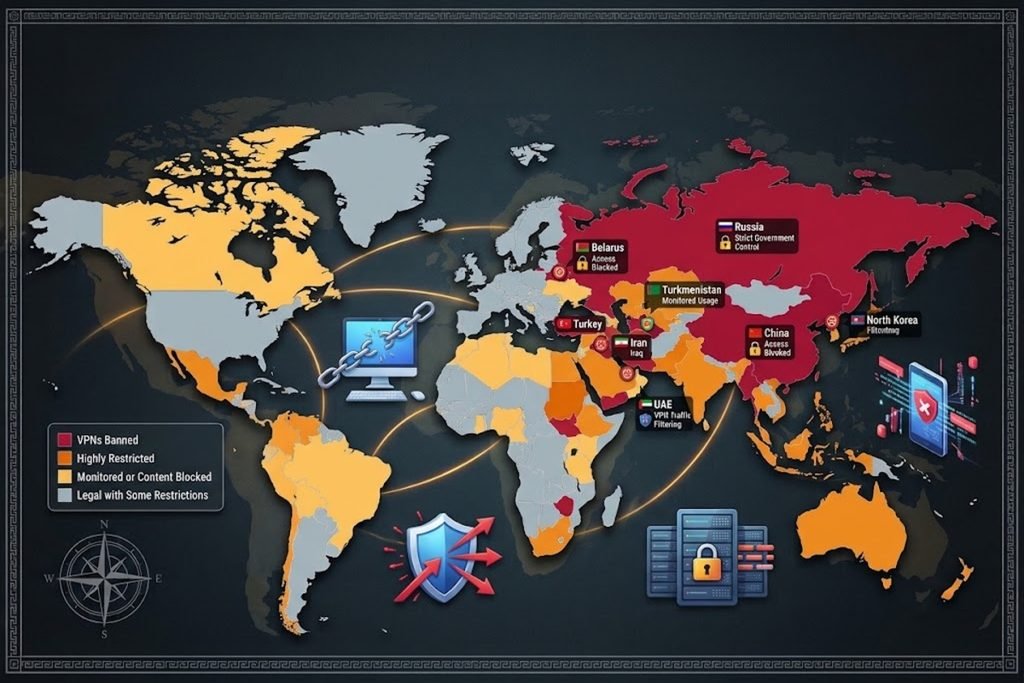
Above all, the FCDO’s country pages are the best official starting point for UK travellers. Here’s what they currently say about VPNs and the internet.
Turkmenistan: VPNs Are Illegal
Turkmenistan is, in fact, the clearest case. According to the FCDO, “VPNs are illegal in Turkmenistan and are usually blocked as soon as the authorities identify them.” In addition, the FCDO says many social media apps and websites are blocked, including YouTube, X, Facebook and WhatsApp.
The FCDO also warns that online comments seen as negative about the political system “may constitute an offence”. Moreover, the state mobile provider doesn’t offer roaming, so your UK phone may not work there.
China: VPNs Must Be Licensed
According to the FCDO, China’s cybersecurity laws mean that “online products and services (for example, VPNs) need to be licensed by the Chinese government”. Furthermore, the FCDO says Google, Facebook, YouTube and X are permanently blocked, and other websites may sometimes be blocked too.
As a result, don’t assume you can use your usual VPN in China. Also, plan how you’ll stay in touch before you go, since many familiar apps won’t work.
United Arab Emirates: It’s About How You Use It
Many guides wrongly describe the UAE as a country that bans VPNs. In reality, the key law is Article 10 of Federal Decree-Law No. 34 of 2021. It punishes anyone who uses another IP address or “any other means” to commit a crime or avoid detection.
Specifically, the penalty is temporary imprisonment and/or a fine of at least AED 500,000, rising to AED 2 million. So the rule is simple: never use a VPN to do anything that’s illegal in the UAE.
The FCDO also warns that in the UAE, “It is illegal to swear and make rude gestures, including online.” Therefore, be just as careful with messages and social media posts as you would be in person.
Turkey: Watch What You Post Online
The FCDO’s Turkey advice doesn’t mention VPNs. However, it warns that insulting the Turkish nation, the national flag, the President or Atatürk is a criminal offence. Moreover, the penalty is 6 months to 3 years in prison, and these laws can apply to online comments “no matter where you were or when you posted them”.
In addition, the FCDO says access to some eSIM services is restricted in Turkey. So check with your eSIM provider before you travel.
Russia, Iran and Belarus: The FCDO Advises Against All Travel
For these three countries, however, the question isn’t really about VPNs. The FCDO advises against all travel to Russia, Iran and Belarus. Also, travelling against FCDO advice may invalidate your travel insurance.
For Russia, the FCDO adds that Meta (Facebook and Instagram), X and LinkedIn are blocked. It also warns that sharing information the authorities consider “fake” can lead to a prison sentence of up to 15 years, including for social media posts.
Other Destinations
VPN rules can change quickly, and some countries aren’t covered in detail by the FCDO. So before any trip, read the “Safety and security” and “Laws and cultural differences” sections of the FCDO page for your destination. If those sections don’t mention VPNs, don’t assume that means anything goes.
What a VPN Can and Can’t Do Abroad
| A VPN can… | A VPN can’t… |
|---|---|
| Encrypt your connection on hotel, airport and café Wi-Fi | Make an illegal activity legal |
| Help you reach UK banking and services more smoothly | Override local laws on what you post online |
| Block ads, trackers and some scam websites | Guarantee access during an internet shutdown |
| Protect several devices at once | Stop your phone being checked at a border |
How to Prepare Your VPN Before You Leave the UK
Here’s a simple checklist to work through before you travel.
- Check the FCDO advice. Read your destination’s page, especially “Safety and security” and “Laws and cultural differences”.
- Install your VPN at home. In addition, sign in and test it on every device before you leave.
- Update your apps. That way, you won’t need to download large updates on slow or restricted networks.
- Turn on the kill switch. It cuts your internet if the VPN drops, so your data isn’t exposed.
- Set up auto-connect. As a result, your VPN switches on whenever you join a new Wi-Fi network.
- Save support details offline. Also keep your login details somewhere secure that doesn’t need the internet.
- Check your eSIM and roaming. For example, the FCDO says some eSIM services are restricted in Turkey.
- Plan a backup way to stay in touch. In particular, agree a phone number or app with family in case your usual apps don’t work.
Surfshark Features That Help UK Travellers
Surfshark’s travel features focus on staying secure on unfamiliar networks. According to Surfshark, they include:
| Feature | What it does, according to Surfshark |
|---|---|
| 4,500+ VPN servers | Lets you connect to servers worldwide, including in the UK |
| Unlimited devices | Covers your phone, laptop, tablet and your family’s devices at once |
| Kill Switch | Cuts your internet connection if the VPN suddenly drops |
| Auto-connect | Connects to the VPN when your device finds a Wi-Fi or Ethernet connection |
| NoBorders | Helps you use the VPN on networks with restrictions, and should activate automatically |
| Obfuscated servers | Hide your VPN use, so your internet provider can’t tell you’re using one |
| Bypasser (split tunnelling) | Lets you remove chosen apps or websites from VPN protection, such as local maps |
| Dynamic MultiHop | Routes your connection through two VPN servers |
| Ad blocker and cookie pop-up blocker | Reduces ads and cookie pop-ups while you browse |
Sources: surfshark.com features pages, Surfshark support and the surfshark.com UK “Compare all features” table, checked 6 November 2026.
However, features like NoBorders and obfuscated servers don’t change the law. So only use them where VPNs are legal, and never to get around the rules in a country such as Turkmenistan.
Which Surfshark Plan Is Right for You?
All three plans include the VPN, unlimited devices and a 30-day money-back guarantee. Beyond that, here’s how they differ:
| Feature | Included in |
|---|---|
| Fast and secure VPN on unlimited devices | All plans |
| Scam protection (scam text protection, email scam checker and web content blocker) | One and One+ |
| Ad blocker and cookie pop-up blocker | All plans |
| Antivirus with real-time protection and webcam protection | One and One+ |
| Bypasser, rotating IP and Dynamic MultiHop | All plans |
| Alert (personal data, credit card and ID leak alerts) | One and One+ |
| Alternative ID (masked email and personal detail generator) | All plans |
| Data removal by Incogni (UK residents included) | One+ only |
| Dedicated IP (available in 20 locations) | Paid add-on |
Source: surfshark.com UK “Compare all features” table, checked 6 November 2026.
For most UK travellers, Starter covers the essentials: the VPN, unlimited devices and ad blocking. On the other hand, One adds scam protection, antivirus and data leak alerts, which are useful if you book and pay for things online while you travel. Meanwhile, One+ adds data removal by Incogni. Note that One+ also lists identity theft coverage, but Surfshark says this is only available to US residents.
Common Mistakes to Avoid

- Assuming UK rules apply abroad. Always check the FCDO page for your destination.
- Waiting until you land to install a VPN. Install and test it before you leave the UK.
- Using a VPN to break local laws. In the UAE, for example, this can lead to prison and a fine of at least AED 500,000.
- Forgetting about what you post. In Turkey, online comments can lead to prosecution, with or without a VPN.
- Ignoring FCDO advice against all travel. It can also affect your travel insurance.
- Relying on one app to stay in touch. Since some countries block popular apps, plan a backup.
Should You Use a VPN on Your Next Trip?
| If you’re travelling to… | Our advice |
|---|---|
| Europe, the USA or most popular destinations | Use a VPN for security on public Wi-Fi |
| The UAE | Use a VPN for security, but never to break local laws |
| Turkey | Check your eSIM first, and be careful with online comments |
| China | Check the latest FCDO advice, as VPNs must be licensed |
| Turkmenistan | Don’t use a VPN, because the FCDO says they’re illegal |
| Russia, Iran or Belarus | Follow the FCDO’s advice against all travel |
Discover how Saily eSIM combines travel data, security features and built-in ad blocking.
Final Verdict
Overall, a VPN is still one of the most useful travel tools for UK travellers in 2027, especially on hotel and airport Wi-Fi. However, the law that applies is the law where you are. Turkmenistan bans VPNs, China requires licensing, and the UAE punishes using a VPN to commit or hide a crime. So check the FCDO advice, set up your VPN before you leave, and use it for security rather than to get around local rules. If you need a VPN for your next trip, compare Surfshark’s Black Friday plans before the deal ends.
FAQs
Is it legal to use a VPN in the UK?
Yes. In July 2026, the government said it “will not ban or age-gate VPNs”, although it will keep the area under review.
Can I use a VPN in Dubai?
Using a VPN isn’t banned in itself. However, under Article 10 of the UAE’s Federal Decree-Law No. 34 of 2021, using another IP address to commit or hide a crime can mean prison and a fine of AED 500,000 to AED 2 million.
Can I use a VPN in China?
According to the FCDO, China’s cybersecurity laws require VPNs to be licensed by the Chinese government. So don’t assume you can use your usual VPN, and check the latest FCDO advice before you travel.
In which country are VPNs illegal?
The FCDO says VPNs are illegal in Turkmenistan and are usually blocked as soon as the authorities identify them. Other countries restrict VPNs in different ways, so always check the FCDO page for your destination.
Is it legal to use a VPN in Turkey?
The FCDO’s Turkey advice doesn’t mention VPNs. However, it warns that insulting the Turkish nation, the flag, the President or Atatürk online is a criminal offence, with or without a VPN.
Should I install a VPN before I travel?
Yes. Install, sign in and test your VPN on every device before you leave the UK, because some countries block VPN apps and websites.
How much is Surfshark’s Black Friday deal?
Surfshark’s Black Friday deal is its 24-month Surfshark One plan, at £1.79 a month, or £48.33 for the first 27 months. Every plan also includes a 30-day money-back guarantee.
Editorial & Accuracy Standards
- Expert Review:
Ammara Azmat,
Senior Travel Mobility Analyst (12+ years experience) - Status: Verified for accuracy against official 2026 service data and real-time traveller reports.
- Our Process: This content follows our Fact-Checking Policy.