
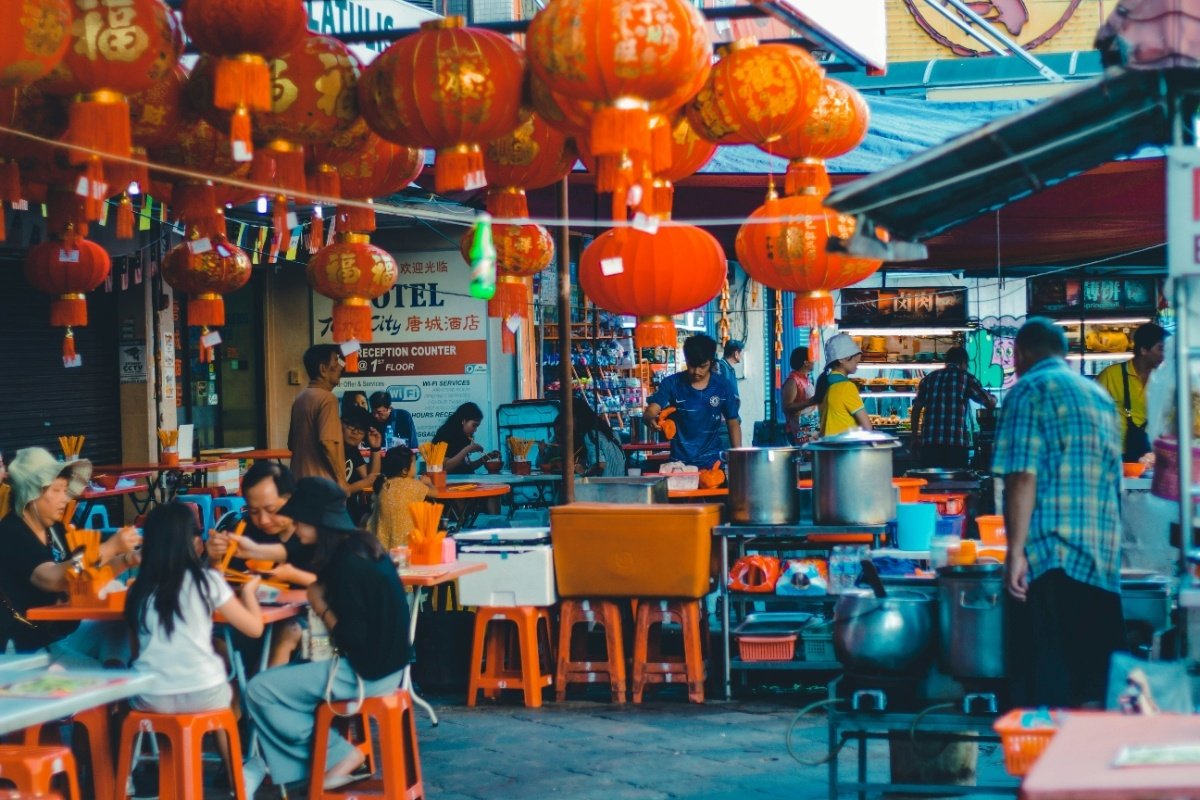
A Traveller Guide to Malaysian Hawker Centres and Mamak Culture
Sunset Weekly Disclosure: To help keep our guides free, this post contains affiliate links. If you click through and make a booking (such as hotels, flights, tours, or travel experiences), we may earn a commission at no extra cost to you. Sunset Weekly is an independent travel and lifestyle publication. While we may receive compensation from affiliate partners, this does not influence our editorial content, recommendations, or opinions. #ad
Quick Answer: Malaysia operates three distinct food cultures simultaneously — Malay, Chinese, and Indian — plus a Peranakan fusion tradition found in Penang and Melaka. Penang is widely regarded as Southeast Asia’s finest street food city. Kuala Lumpur delivers extraordinary variety at very low prices. Food here is genuinely cheap, halal options are abundant, and the mamak stall — a 24-hour Indian-Muslim institution — feeds the country at every hour of the day and night.
Editorial note: This guide covers Peninsular Malaysia and both Bornean states with attention to practical eating, pricing, and realistic traveller expectations. Pricing reflects 2025–2026 conditions. No restaurants, tourism boards, or commercial operators have contributed to or influenced this content.
Malaysia has no single food identity. Indeed, this is its greatest strength. Three major ethnic communities — Malay, Chinese, and Indian — each maintain distinct culinary traditions. Moreover, these operate side by side in hawker centres, coffee shops, and market streets across the country. Consequently, a single meal at a hawker centre might involve Malay nasi lemak at one stall, Chinese char siu at the next, and Indian roti canai at the third. No other country in Southeast Asia offers this range at comparable prices. Furthermore, the Peranakan kitchen of Penang and Melaka adds a fourth tradition — a centuries-old fusion of Chinese and Malay cooking that produces some of the most complex flavours in the region.
What Food Is Malaysia Known For?
Answer: Malaysia is known for nasi lemak (the national dish), laksa, char kway teow, roti canai, satay, bak kut teh, nasi kandar, cendol, and teh tarik. However, the country’s food identity rests as much on the hawker centre format and the mamak stall culture as on any individual dish. Penang’s street food scene carries its own global reputation entirely separate from the rest of the country.
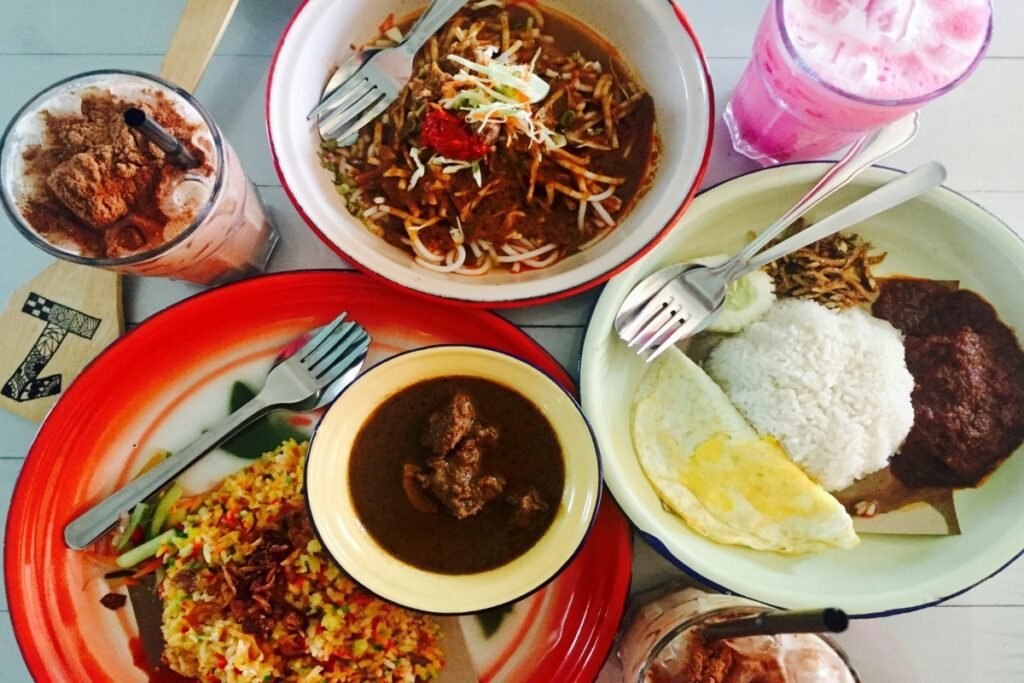
Malaysian food builds on three culinary foundations. Malay cooking uses coconut milk, galangal, lemongrass, tamarind, and belacan (shrimp paste) as primary flavour carriers. Chinese-Malaysian food ranges from Hokkien and Teochew shophouse cooking in Penang to Cantonese roast meats and dim sum in Kuala Lumpur. Indian-Malaysian food divides between Tamil vegetarian banana leaf rice and the Indian-Muslim mamak tradition of roti canai, mee goreng, and nasi kandar.
Additionally, the Peranakan (Nyonya) kitchen of Penang and Melaka produces dishes that combine Chinese cooking techniques with Malay spice pastes. Dishes like ayam pongteh (pork or chicken in fermented soybean paste), buah keluak (chicken with the nut of the keluak tree), and Nyonya laksa have no direct equivalent in either parent cuisine. Specifically, this food requires long preparation and deep ingredient knowledge. It produces flavours of unusual complexity.
Malay, Indian, and Peranakan Dishes
| Dish | Community | What It Is | Best Context |
|---|---|---|---|
| Nasi lemak | Malay | Coconut rice with sambal, fried anchovies, egg, and peanuts | Everywhere; wrapped in banana leaf at breakfast stalls |
| Roti canai | Indian-Muslim | Flaky, layered flatbread; served with dhal or curry | Mamak stalls; all hours; best ordered with teh tarik |
| Penang asam laksa | Peranakan/Malay | Sour tamarind fish broth with thick rice noodles | Penang only; this version does not travel well |
| Nasi kandar | Indian-Muslim | Rice with a choice of curries and side dishes ladled over the top | Penang; Line Clear and Hameediyah are the key names |
| Satay | Malay | Skewered and grilled meat with peanut sauce and ketupat | Kajang (the satay capital); hawker centres across the country |
| Cendol | Malay/Peranakan | Shaved ice with coconut milk, pandan jelly strands, and palm sugar syrup | Penang’s Jalan Penang stalls; hawker centres everywhere |
| Nyonya buah keluak | Peranakan | Chicken or pork in a rich paste made from the keluak nut | Peranakan restaurants in Penang and Melaka |
| Ikan bakar | Malay | Marinated fish grilled over charcoal; served with sambal | Coastal towns; Umbai in Melaka; Batu Maung in Penang |
Chinese-Malaysian and Cross-Community Dishes
| Dish | Community | What It Is | Best Context |
|---|---|---|---|
| Curry laksa | Chinese-Malay | Coconut milk curry broth with noodles and prawns | KL and central Malaysia; a separate dish from asam laksa |
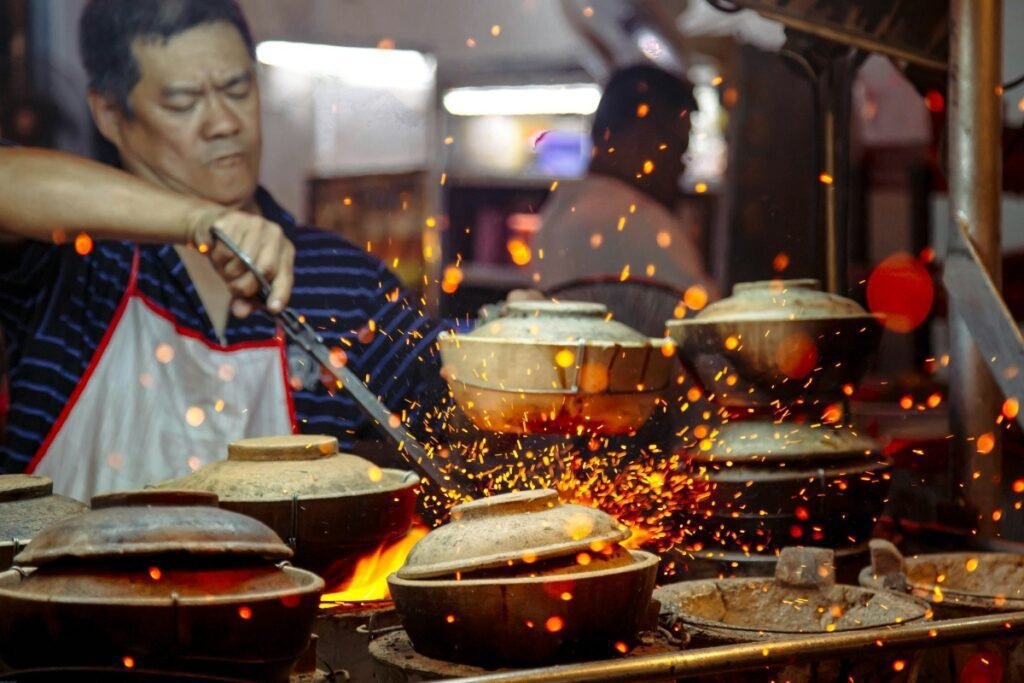
| Char kway teow | Chinese (Hokkien) | Flat rice noodles stir-fried with egg, prawns, and lard | Penang; best from a specialist wok vendor |
| Hokkien mee (Penang) | Chinese (Hokkien) | Thin yellow noodles in rich prawn broth with egg noodles | Penang only; completely different from KL hokkien mee |
| Hokkien mee (KL) | Chinese (Hokkien) | Thick yellow noodles in dark, caramelised prawn sauce | KL; a different dish sharing the same name |
| Bak kut teh | Chinese | Pork ribs slow-cooked in herbal broth; served with rice and you char kway | Klang (the origin) and KL; not available at halal establishments |
| Teh tarik | Indian-Muslim | Hot tea with condensed milk, poured between cups for froth | Mamak stalls; the definitive Malaysian drink |
Understanding Malaysia’s Regional Food Cultures
Answer: Malaysia’s food divides clearly by region. Penang carries the deepest and most celebrated street food tradition on the Peninsula. Kuala Lumpur offers the greatest variety. Melaka provides the best access to Peranakan cuisine. Sarawak and Sabah in Borneo operate distinct food cultures rarely found on the Peninsula — their dishes represent the country’s most underexplored culinary territory.
Penang: The Street Food Capital
Penang consistently draws the most serious food attention of any Malaysian destination. Its UNESCO-listed George Town contains a concentration of hawker stalls, kopitiams (Chinese coffee shops), and family-run restaurants that have operated for generations. Consequently, the food here reflects accumulated skill rather than tourist reinvention.
The key dishes of Penang are specific to the island. Asam laksa — a sour tamarind fish soup with thick rice noodles — bears no resemblance to the coconut-based curry laksa served in KL. Char kway teow cooked over an extremely hot wok by a specialist vendor differs fundamentally from the versions found elsewhere. Hokkien mee in Penang means a clear, intense prawn-based broth; in KL, it means something entirely different. These distinctions matter practically. Ordering Penang dishes outside Penang often produces disappointment.
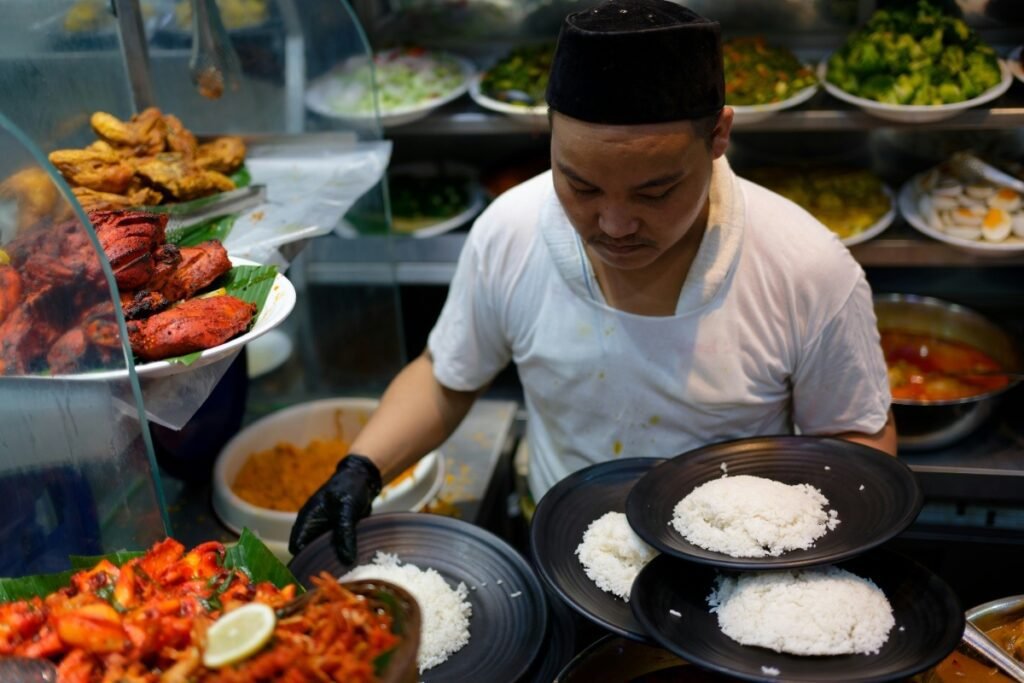
Gurney Drive Hawker Centre is Penang’s most famous and most tourist-facing food destination. However, it still produces reliable versions of the island’s classics. Lorong Baru (New Lane) Hawker Centre operates with a more local clientele and lower prices. Nasi kandar — rice with a selection of curries and gravies ladled over the top — is an Indian-Muslim institution specific to Penang. The original operators, from the Perai area of the Penang mainland, have run their businesses for generations.
Kuala Lumpur: Everything, at a Price
Kuala Lumpur is not the food capital of Malaysia. However, it is the most accessible entry point into Malaysian food diversity. Every regional cuisine appears here. Furthermore, the price premium over provincial cities and Penang is modest in hawker and kopitiam contexts.
Jalan Alor in Bukit Bintang concentrates Chinese hawker stalls into a single tourist-facing street. The food is competent. The experience is loud, chaotic, and heavily oriented toward international visitors. Prices run higher than equivalent stalls in residential areas. Specifically, the same char kway teow costs 30–50% more on Jalan Alor than in a kopitiam ten minutes away.
Chow Kit Market produces some of KL’s most authentic Malay market food. The area caters primarily to a working-class and market-trader clientele. Masjid India and Brickfields (Little India) concentrate Indian food into manageable walking areas. Petaling Street (KL Chinatown) retains some good Chinese hawker stalls, though tourist pressure has reduced the overall quality of the surrounding area.
The mamak stall deserves special attention in KL. These Indian-Muslim establishments operate 24 hours. They serve roti canai, mee goreng, teh tarik, and nasi kandar at very low prices to every segment of the population. The mamak is where Malaysian society eats together regardless of ethnicity or religion. Consequently, it functions as a social institution as much as a food operation.
Melaka: Peranakan Heritage
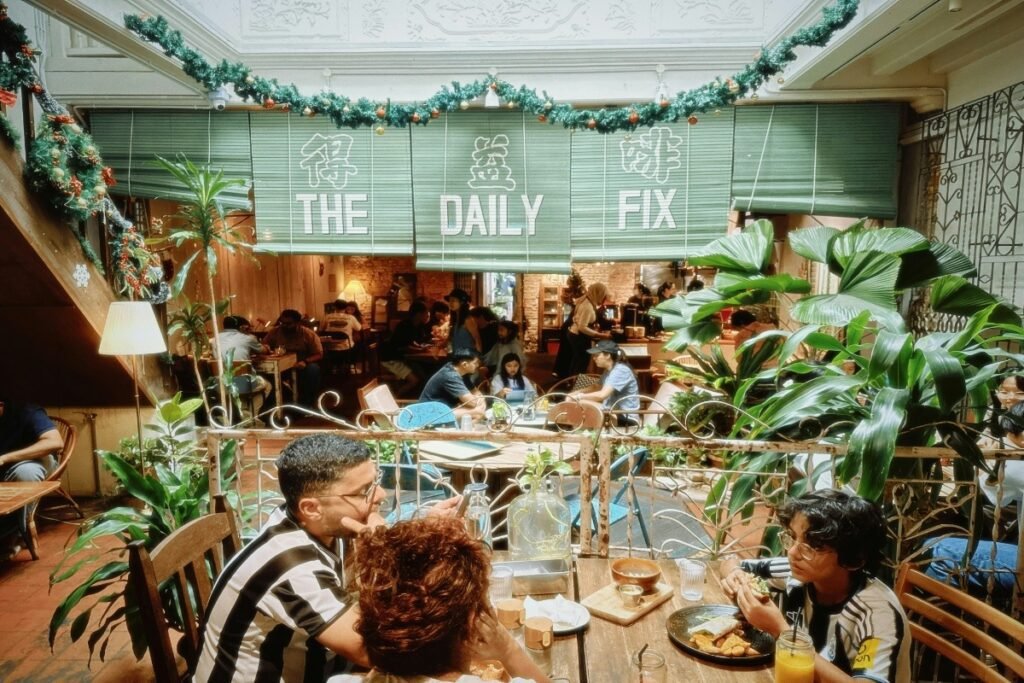
Melaka (Malacca) holds the deepest concentration of Peranakan restaurant culture on the Peninsula. Specifically, the Nyonya kitchen of Melaka differs from Penang’s Nyonya food in subtle but meaningful ways. Melaka Nyonya cooking tends toward slightly sweeter profiles; Penang Nyonya leans more sour and spiced.
The streets around Jonker Street (Jalan Hang Jebat) concentrate Nyonya restaurants, but they face considerable tourist traffic. Consequently, prices run above the local norm and some operations have simplified their menus for international palates. Moving one or two streets away from Jonker Street consistently produces better Nyonya cooking at lower prices. Additionally, Melaka’s Umbai waterfront produces excellent ikan bakar (grilled fish) at a cluster of riverside Malay restaurants drawing weekend crowds from KL.
Sarawak and Sabah: Borneo’s Distinct Traditions
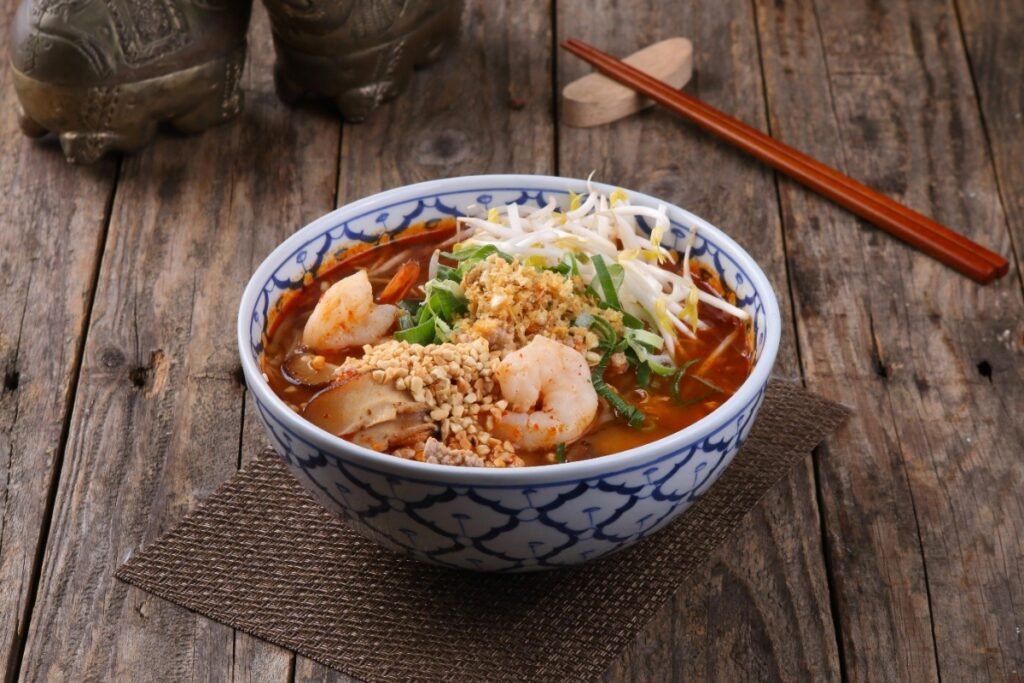
Sarawak laksa is a completely separate dish from any laksa found on the Peninsula. It uses sambal belacan, coconut milk, and egg vermicelli in a complex spiced broth topped with prawns, omelette strips, and fresh coriander. Specifically, Anthony Bourdain once described it as the breakfast of the gods — a characterisation reflecting genuine enthusiasm rather than marketing.
Kolo mee — dry, springy noodles with char siu pork, minced meat, and a light vinegar-oil dressing — appears only in Sarawak. It represents the region’s most distinctive everyday dish. Furthermore, Kuching, Sarawak’s capital, has a concentrated hawker scene built around these dishes at very low prices. Indeed, Kuching arguably offers the best value eating in Malaysia outside of a mamak stall.
Sabah produces exceptional seafood from the Sulu and South China Seas. Kota Kinabalu holds a night market at Jalan Gaya and a seafood strip at the Filipino Market that draw both local residents and visitors. However, prices at tourist-facing seafood restaurants exceed what comparable fresh seafood costs at morning markets and local kopitiam settings. Specifically, the Gaya Street Sunday Market provides the most honest local food experience in the city.
How Expensive Is Food in Malaysia?
Answer: Malaysia ranks among the cheapest food destinations in Southeast Asia. A full day of eating well at hawker stalls and kopitiams typically costs RM 25–50 (approximately £4.30–£8.60). Mid-range restaurant meals cost RM 30–80 per person (£5.15–£13.70). Only fine dining in KL and tourist-zone restaurants in Penang and Melaka significantly exceed these figures.
Pricing by Meal Type
| Meal Type | RM | Approx. GBP | Notes |
|---|---|---|---|
| Nasi lemak (hawker stall) | 2–6 | £0.35–£1.00 | Banana leaf version at roadside stalls |
| Roti canai with dhal (mamak) | 2–4 | £0.35–£0.70 | Malaysian breakfast staple |
| Hawker stall single dish | 5–15 | £0.85–£2.55 | Quality not linked to price in this range |
| Teh tarik (mamak stall) | 2–4 | £0.35–£0.70 | Frothy pulled tea; the national drink |
| Penang char kway teow (specialist stall) | 8–14 | £1.35–£2.40 | Higher price reflects quality lard and wok hei |
| Set lunch (kopitiam) | 8–18 | £1.35–£3.10 | Rice, main, vegetable, soup, drink |
| Nasi kandar (Penang, full plate) | 10–20 | £1.70–£3.40 | Price rises with the number of side dishes |
| Mid-range dinner (sit-down restaurant) | 30–80 | £5.15–£13.70 | Per person with drink; no service charge at casual restaurants |
| Fine dining tasting menu (KL) | 250–600 | £43–£103 | Before wine; significantly cheaper than equivalents in Europe |
| Tiger/Carlsberg beer (restaurant) | 15–28 | £2.55–£4.80 | Alcohol attracts sin tax; significantly more expensive than food |
| Fresh coconut water (stall) | 3–6 | £0.50–£1.00 | Widely available; excellent in the heat |
| Cendol (Penang stall) | 3–6 | £0.50–£1.00 | Better at established Penang stalls than elsewhere |
Tipping in Malaysia
Malaysia has no tipping culture at hawker stalls, kopitiams, or casual restaurants. However, mid-range and upmarket restaurants frequently add a 10% service charge and 6% SST (Sales and Service Tax) to bills. This appears as separate line items. Consequently, the final bill at a sit-down restaurant in KL or Penang can run 16% above the listed menu prices. Budget accordingly. Staff expect no further tip beyond the service charge.
Hawker Centres, Kopitiams, and Mamak Stalls
Answer: Three eating formats define Malaysian food culture. Hawker centres group independent stalls around shared seating — each stall specialises in one or two dishes. A kopitiam is a Chinese coffee shop operating from a permanent shophouse, with a few stalls and a drinks vendor. The mamak stall is the Indian-Muslim 24-hour institution serving roti canai, teh tarik, and mee goreng. Understanding these three formats makes Malaysia’s food landscape immediately navigable.
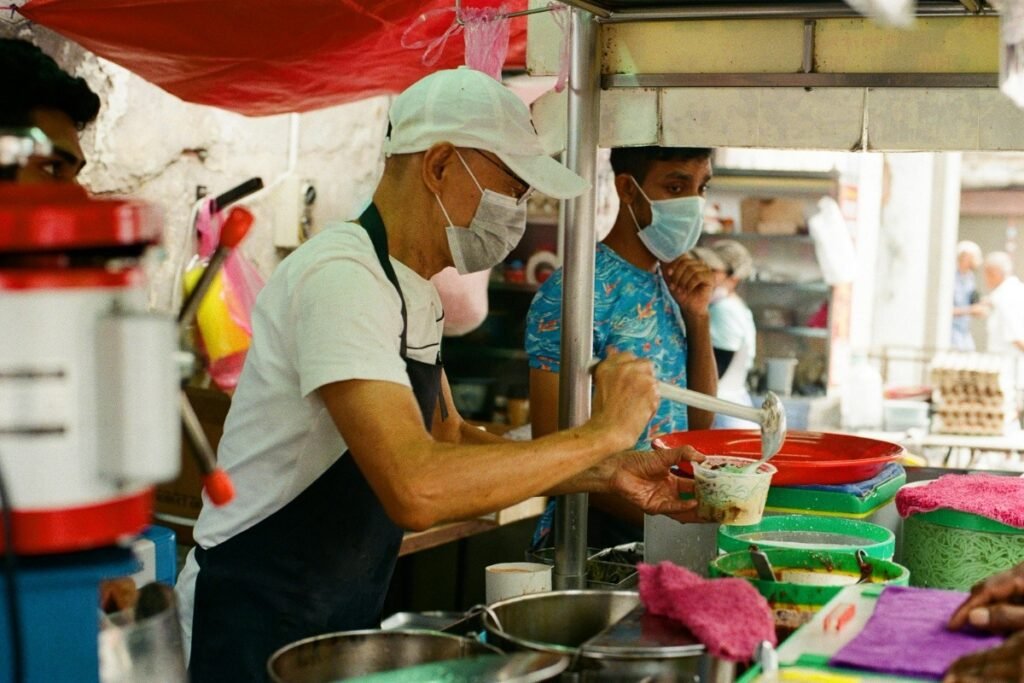
How the Hawker Centre Works
A hawker centre is not a food court. Each stall operates independently. Vendors specialise — a single stall may cook only char kway teow, only Hokkien mee, or only satay. Specifically, this specialisation produces a quality level that multi-dish restaurants rarely match. A vendor who has cooked one dish for twenty years develops a precision that shows.
The format is simple. Choose a table. Walk to whichever stalls appeal. Order and pay at each stall individually. The food comes to your table. At busy centres, a stall helper sometimes collects orders from diners already seated. Additionally, drinks vendors operate separately from food stalls — ordering your teh tarik first and then wandering stalls is the standard sequence.
The Kopitiam
The kopitiam (from Hokkien: coffee shop) is a Chinese-Malaysian institution. It occupies a permanent shophouse and typically opens early in the morning. Roast meats — char siu (barbecued pork) and siu yuk (crispy pork belly) — hang in the window. Stalls inside serve wonton noodles, congee, and dim sum at weekends. The drinks counter serves kopi and teh-o (black tea with sugar).
The kopitiam culture anchors Chinese-Malaysian morning life. Weekend dim sum sessions at kopitiams across Malaysia draw families from 07:00 onwards. By 10:00, seating at a popular kopitiam becomes difficult. Consequently, arriving early produces both better seating and fresher food.
The Mamak Stall
The mamak stall is Malaysia’s most democratic food institution. Indian-Muslim operators run these establishments around the clock. They serve roti canai in multiple variations — with dhal, with curry, as a banana-stuffed dessert version (roti pisang), or as a crispy disc (roti tisu). Mee goreng mamak (fried noodles) and nasi kandar appear on most menus alongside teh tarik, Milo, and freshly squeezed fruit juices.
Furthermore, the mamak stall functions as the country’s primary late-night eating option. After midnight in KL or Penang, mamak stalls carry full service while most other establishments have closed. Critically, mamak food is halal — it serves Muslim Malay customers, Chinese non-Muslims, and Indian customers simultaneously. This cross-ethnic patronage makes the mamak stall unique in Malaysian food culture.
Malaysia’s Drinking Culture
Answer: Malaysia’s national drink is teh tarik — hot tea with condensed milk, poured between cups to produce froth. The country also drinks kopi (Malaysian-style coffee with condensed milk or butter), Milo, fresh sugarcane juice, coconut water, and calamansi juice widely. Alcohol is legally available but expensive due to sin taxes. Malaysia’s Muslim-majority population generally does not drink alcohol — Chinese and Indian communities do.
Hot Drinks: Teh Tarik and Kopi
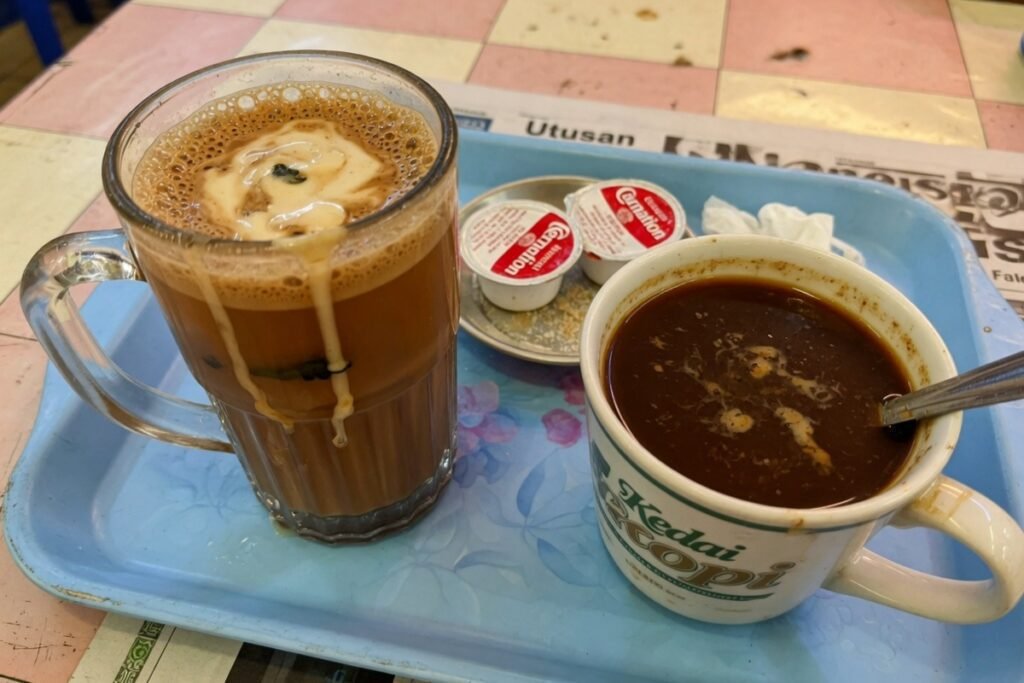
Teh tarik is made from strong Ceylon tea and condensed milk. The “pulling” technique — pouring the tea between two cups repeatedly from height — aerates it and produces a characteristic froth. Specifically, a good teh tarik should arrive hot, foamy on top, and sweet without being cloying.
Kopi refers to Malaysian-style coffee made from beans roasted with sugar and butter, brewed through a muslin sock. The result is intense, slightly bitter, and very different from espresso. However, various ordering codes apply: kopi-o means black with sugar; kopi-o kosong means black without sugar; kopi means with condensed milk; kopi-c means with evaporated milk. Mastering the kopi ordering system opens access to one of Malaysia’s most distinctive drink traditions.
Cold Drinks and Juices
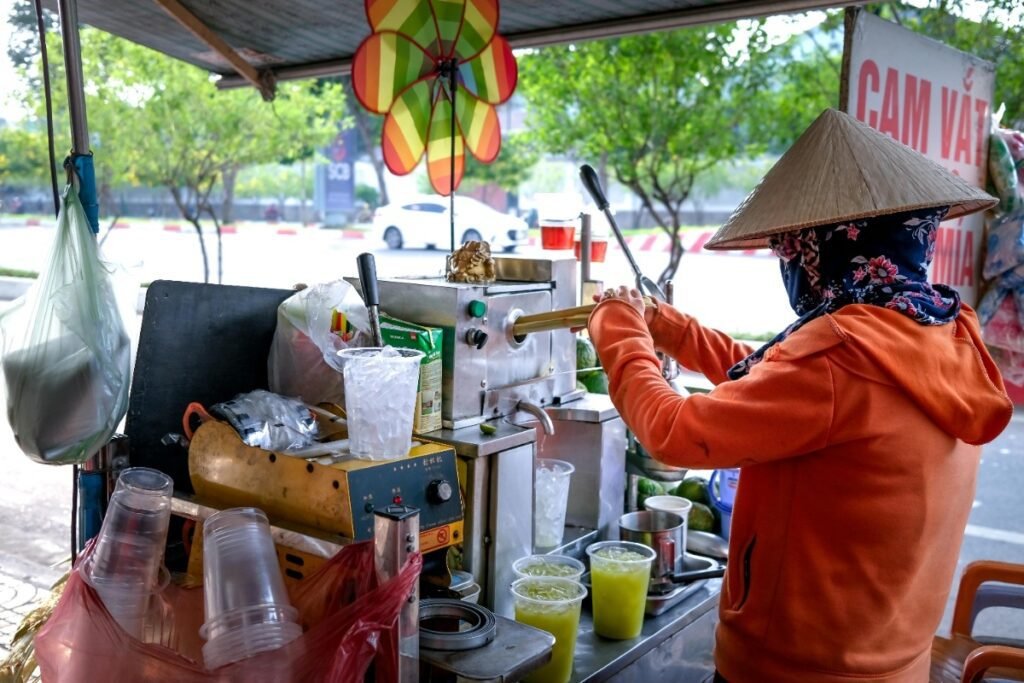
Sugarcane juice presses fresh sugarcane through a manual or electric press. It costs RM 2–4 from street stalls. It tastes cleaner and less sweet than the bottled version. Calamansi juice — made from the small, intensely sour Malaysian lime — comes freshly squeezed at kopitiam counters, diluted with water or soda. Both drinks pair exceptionally well with the rich, oily food that defines hawker centre eating.
Bandung — a rose syrup and evaporated milk drink traditionally associated with Malay celebrations — appears at mamak stalls and Malay restaurants. Additionally, Air bandung poured over ice is a standard option at most hawker centres across the country.
Alcohol
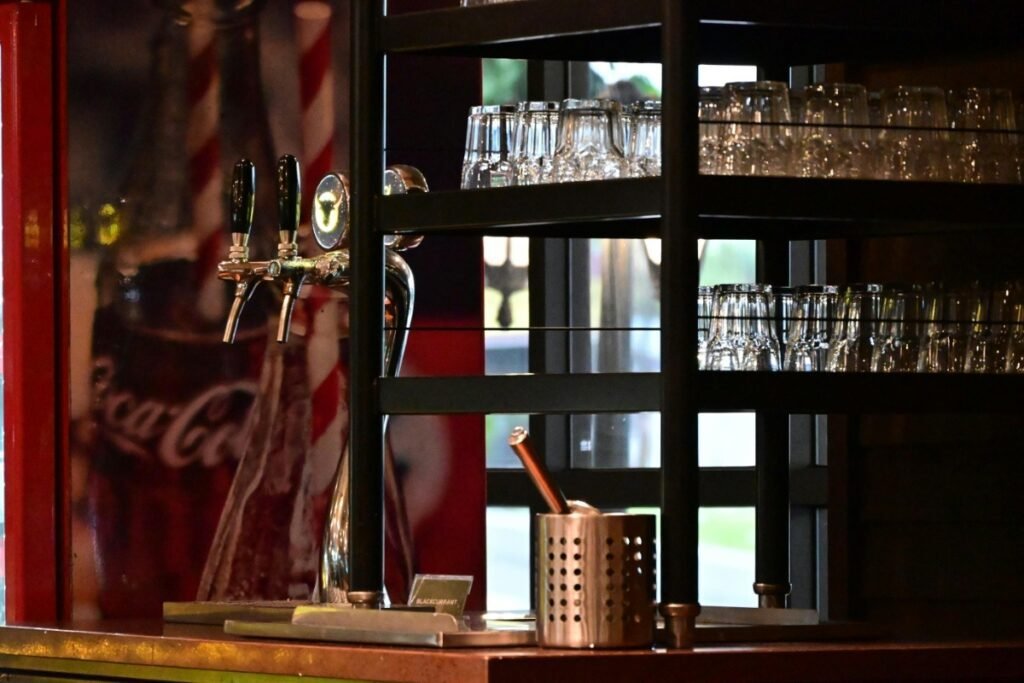
Alcohol is legally available in Malaysia and widely sold at supermarkets, Chinese restaurants, hotel bars, and non-halal establishments. Tiger Beer and Carlsberg dominate — both produce locally. However, sin taxes make alcohol significantly more expensive relative to food. A bottle of Tiger Beer at a Chinese restaurant costs RM 15–28 (£2.55–£4.80), while a full plate of food at the same establishment costs RM 8–15.
Malay establishments — including all mamak stalls — do not serve alcohol. This reflects the halal requirement rather than a blanket legal restriction. Consequently, Chinese kopitiam and restaurant settings provide the most natural context for drinking beer alongside food.
What Should Tourists Avoid?
Answer: The main tourist-food traps in Malaysia concentrate around KLCC and the Petronas Towers area in KL, Jalan Alor on weekend evenings, and the Jonker Street corridor in Melaka. However, Malaysia’s tourist-food problem is less severe than in many comparable destinations. The price gap between tourist-facing and local-facing food rarely exceeds 50–80%.
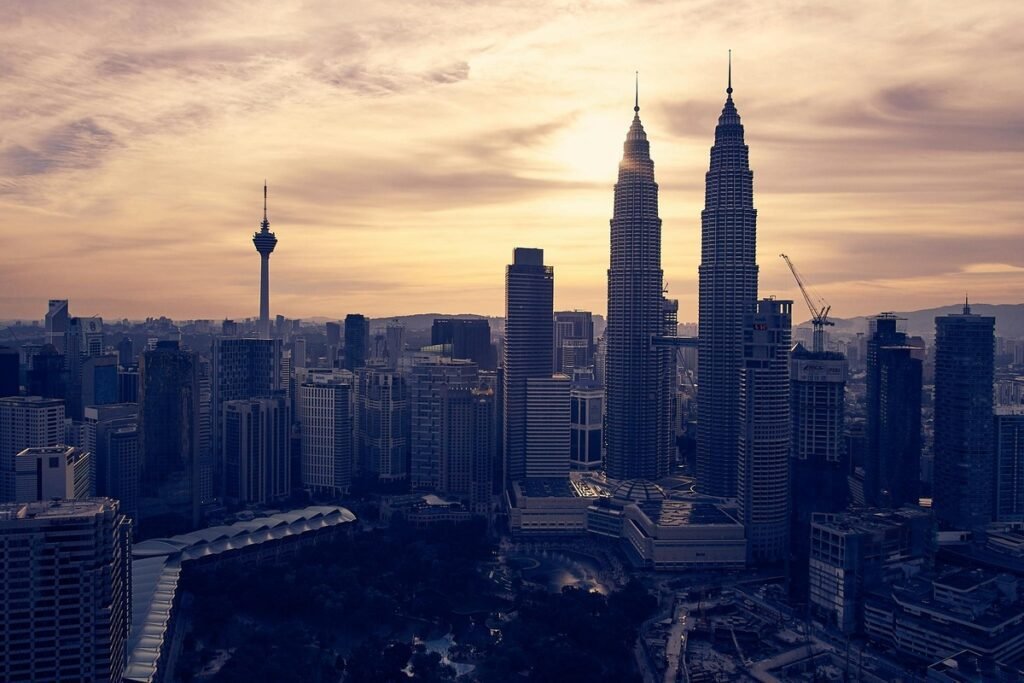
KL Tourist Zones
Restaurants within the KLCC mall complex and on the Petronas Towers concourse charge international hotel prices for food that shows no particular ambition. Specifically, a laksa in this context costs RM 25–45. The same laksa at a nearby kopitiam costs RM 8–12. The quality differential rarely justifies the price gap.
Jalan Alor on weekend evenings becomes congested and loud. Vendors target international visitors. Prices run 30–50% above comparable stalls in residential areas. However, the street still produces edible and occasionally good food. Going on a Monday or Tuesday evening produces a calmer experience at fairer prices.
Ordering Mistakes
Ordering curry laksa in Penang and expecting Penang laksa: These are different dishes. Penang’s famous laksa is the sour asam variety. Curry laksa (coconut milk based) exists in Penang but represents the KL tradition rather than the local one. Specifically, asking for “laksa” in Penang without clarification typically produces the asam version. This is correct.
Ignoring durian season: Durian — the intensely flavoured, strongly scented fruit banned from most hotel lobbies — reaches peak season between June and August. During this window, fresh durian from dedicated stalls costs RM 15–40 per kilogram. Specifically, this represents the most affordable access to extraordinary fruit quality available anywhere in the world. Avoiding durian because of the smell means missing one of Malaysia’s most important food experiences. Furthermore, the smell outdoors at a durian stall is considerably more manageable than its reputation suggests.
Traveller Practicality: Halal, Vegetarians, Families
Answer: Halal food is the default in Malaysia — most Malay and mamak establishments are fully halal. Vegetarians eat well through Indian banana leaf rice restaurants and Tamil vegetarian kopitiam stalls. However, confirming halal status at Chinese restaurants matters for Muslim travellers, as pork and lard appear widely in Chinese-Malaysian cooking. Families eat well across all formats.
Halal and Non-Halal
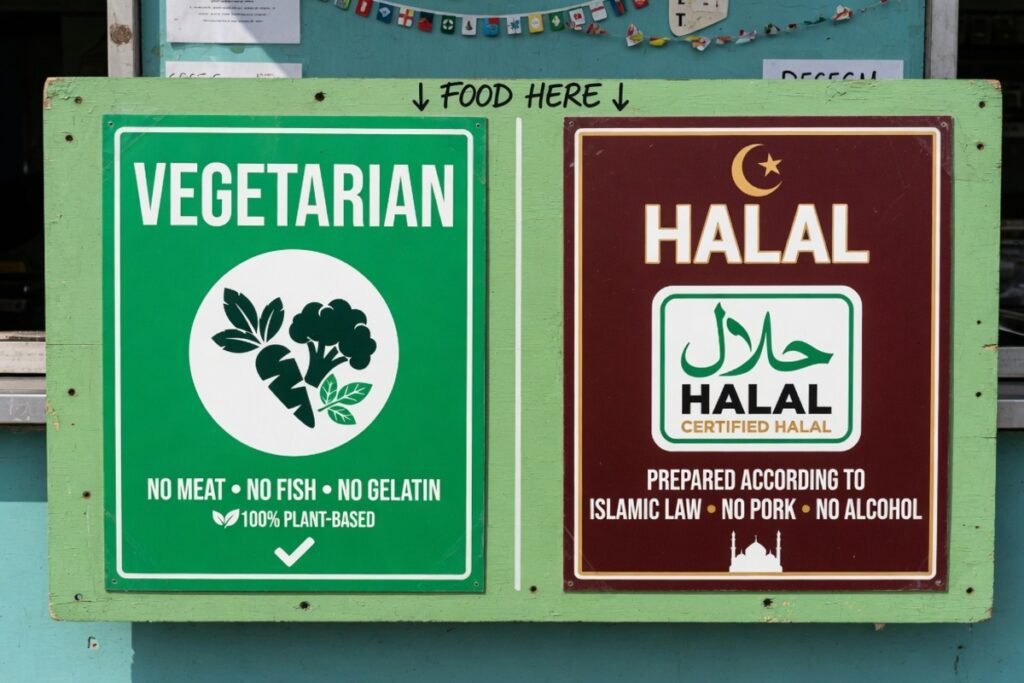
Malaysia’s food landscape divides clearly by halal status. All Malay restaurants, mamak stalls, and most Indian establishments are halal. Chinese restaurants and kopitiams may use pork and lard extensively — these establishments typically do not carry halal certification. Specifically, bak kut teh (pork rib soup), char siu (roast pork), and char kway teow cooked with lard are not halal.
For Muslim travellers, identifying halal establishments is straightforward. Halal certification appears on signage. Malay and Indian-Muslim restaurants carry it consistently. Furthermore, when in doubt, mamak stalls provide reliable halal food at very low prices around the clock.
Vegetarian Reality
Indian vegetarian food in Malaysia is genuinely outstanding. Banana leaf rice — a Tamil tradition of rice with multiple vegetable curries, dhal, rasam, and papadum served on a banana leaf — appears at Indian restaurants across every Malaysian city. Additionally, Buddhist vegetarian restaurants (marked with the 素 character) appear in Chinese communities and exclude meat entirely.
However, confirming vegetarian status at Chinese hawker stalls requires care. Wok seasoning, broth bases, and sauces at Chinese stalls may contain meat-derived ingredients. Specifically, asking “ada daging tak?” (is there meat?) in Malay resolves most situations. Indian banana leaf restaurants represent the most reliable vegetarian option in Malaysia without needing to interrogate ingredients.
Families and Allergy Awareness
Malaysian restaurants welcome families without ceremony. Children eat at hawker centres, sit-down restaurants, and mamak stalls alongside adults at all hours. Peanuts appear widely — in satay sauce, as nasi lemak garnish, and in various kuih (traditional snacks). Shellfish appears across Malay and Chinese dishes. Consequently, travellers with these allergies should identify them clearly at each ordering interaction.
Local Dining Etiquette in Malaysia
Answer: Malaysian dining etiquette varies by the community context. At Malay and Indian restaurants, eating with the right hand is customary and respectful. At Chinese establishments, chopsticks and spoons are standard. Tipping is not expected at hawker stalls or mamak stalls. A 10% service charge applies at mid-range and upmarket restaurants. No one rushes diners from tables.
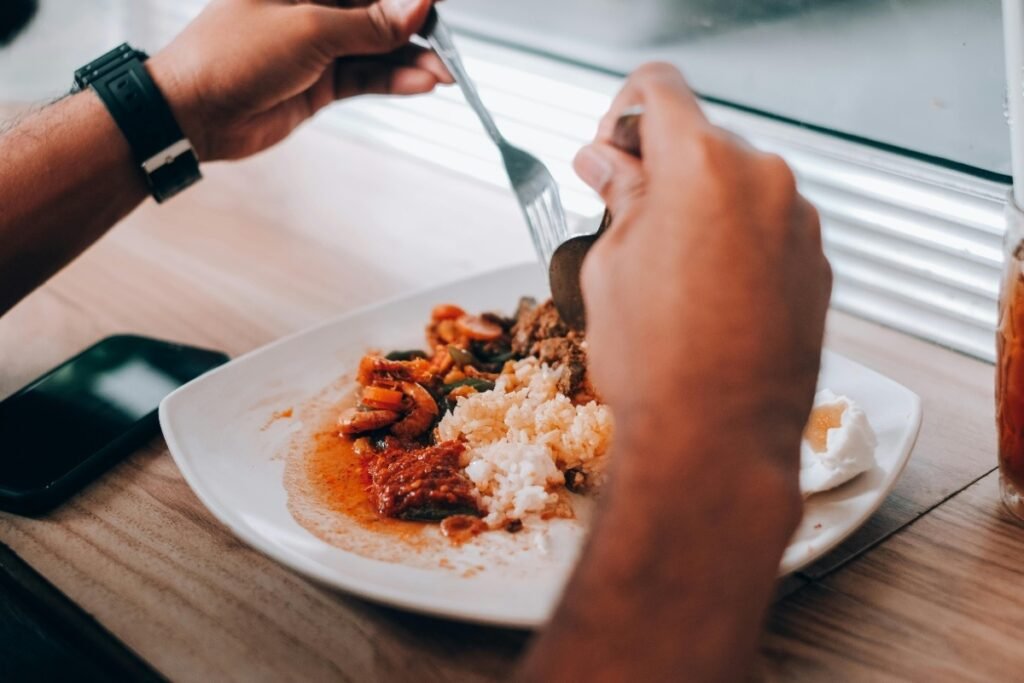
Eating with Your Hands
At Indian banana leaf rice restaurants, eating with the right hand is both acceptable and culturally appropriate. Specifically, the technique involves using the tips of the fingers — not the whole hand — to mix rice with curry and scoop it to the mouth. Staff bring food without cutlery unless requested. Requesting a spoon is entirely acceptable. However, left-hand eating carries negative cultural associations in Malay and Indian contexts.
At banana leaf rice restaurants, a server passes with additional rice and curry. The correct response when you have eaten enough is to fold the banana leaf toward you (away from your body). However, folding it away from you — toward the server — signals that someone has died. This is a significant cultural error in a restaurant context. Specifically, local diners find it jarring and it creates an awkward moment that is best avoided entirely.
Practical Ordering Notes
At hawker centres, sharing tables with strangers is normal and expected. Seating is communal. Specifically, placing a tissue packet or a personal item on a chair reserves a seat while you order. This system is universally understood. Attempting to sit at a reserved seat (marked by a tissue packet) creates friction unnecessarily.
Bills at kopitiam and hawker settings arrive per-stall. Each vendor tracks their own sales. Consequently, paying each stall individually — rather than attempting a single combined payment — reflects the actual operating system. Furthermore, carrying small bills (RM 5, 10, 20) makes these transactions faster for both parties.
Best Areas for Food by Budget and Traveller Type
| Traveller Type | Best Area | Why |
|---|---|---|
| Street food and hawker culture | Penang (George Town) | The deepest hawker tradition in Southeast Asia |
| Peranakan/Nyonya cuisine | Penang and Melaka | The only locations with genuine Peranakan restaurant culture |
| Malay food traditions | Chow Kit (KL) or any Malay market town | Nasi lemak, rendang, asam pedas at their most honest |
| Indian food (vegetarian) | Brickfields (KL) or Penang’s Little India | Banana leaf rice; Tamil cuisine at accessible prices |
| Mamak culture | Anywhere in KL or Penang | 24-hour access; socially cross-cultural; extremely cheap |
| Sarawak food | Kuching (Sarawak) | Sarawak laksa, kolo mee; completely distinct from the Peninsula |
| Seafood | Kota Kinabalu (Sabah) or coastal Penang | Fresh catch from the Sulu Sea and Strait of Malacca |
| Durian | Penang or any roadside stall June–August | Fresh durian at lowest price and highest quality |
| Budget eating | Any mamak stall in any Malaysian city | Full meal under RM 10; open 24 hours |
| Short stay (1–2 days) | Penang (George Town) | Best food density per square kilometre in Malaysia |
Where To Stay in Malaysia?
Agoda provides broad Malaysia coverage with over 102,000 listed properties, making it effective for comparing city hotels, beach resorts, and business stays across regions. In practice, the platform excels when you already know your preferred trip style — its search tools support fast filtering by destination, price, dates, and guest ratings rather than in-depth editorial guidance or curated recommendations.
The geographic logic across highlighted properties is straightforward: Kota Kinabalu as a Sabah city and nature base, Penang for beach and heritage time, Kuala Lumpur for premium urban convenience and transport links, and Melaka for heritage sightseeing. This makes Agoda a high-volume booking marketplace with wide inventory, where final hotel selection should hinge on exact address, neighbourhood characteristics, station or beach proximity, and whether you need a resort, luxury tower, or central business hotel rather than brand name alone.
| Hotel & Location | Best For | Unique Feature | Verified Rating | Action |
|---|---|---|---|---|
|
Grand Hyatt Kuala Lumpur 12 Jalan Pinang, 50450 Kuala Lumpur, Malaysia |
Luxury & KLCC Access | Next to Kuala Lumpur Convention Centre and close to the Petronas Twin Towers. | 9.2/10 | BOOK NOW |
|
Hilton Kota Kinabalu Jalan Tunku Abdul Rahman, Asia City, Kota Kinabalu, Sabah, 88000, Malaysia |
City Stays & Transit | Full-service urban hotel in Asia City, about 15–18 minutes from the airport. | 9.0/10 | BOOK NOW |
|
PARKROYAL Penang Resort Batu Ferringhi Beach, 11100 Batu Ferringhi, Penang, Malaysia |
Beach & Family Holidays | Direct beach location with sea or hill views and outdoor resort facilities. | 9.0/10 | BOOK NOW |
|
Grand Millennium Kuala Lumpur 160 Jalan Bukit Bintang, 55100 Kuala Lumpur, Malaysia |
Shopping & Nightlife | Prime Bukit Bintang address with immediate access to major malls. | 8.7/10 | BOOK NOW |
|
Hatten Hotel Melaka Melaka, Malaysia |
Historical City Breaks | Agoda lists it in its Malaysia inventory, but the snippet here does not expose the hotel’s full address details. | 8.4/10 | BOOK NOW |
Important Things Travellers Should Know Before Eating in Malaysia
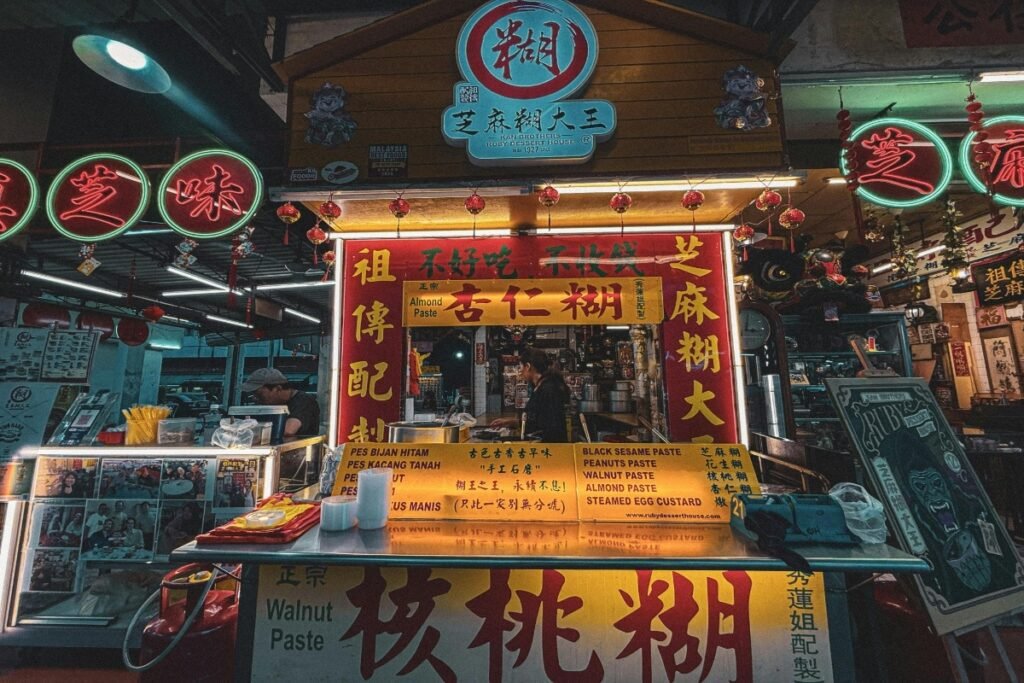
Timing, Seasons, and Practical Notes
- Hawker stalls operate specific hours. Morning stalls serve breakfast and early lunch. Evening stalls run from 18:00 onwards. Many of Penang’s most celebrated vendors operate only in the morning and close by noon. Consequently, planning specific food pilgrimages around stall hours matters in Penang more than anywhere else in the country.
- Durian season runs June to August. Outside this window, fresh durian is hard to find and expensive when available. If your visit falls within the season, try it from a dedicated durian stall rather than a hotel dessert menu. The cost difference is enormous and the quality difference is meaningful.
- The 10% service charge is not a tip request. It appears automatically on bills at mid-range and upmarket restaurants. Staff expect no additional gratuity beyond this. At hawker stalls, kopitiams, and mamak stalls, no service charge applies.
- Alcohol prices reflect sin taxation. A meal at a Chinese restaurant costs far less than the beer consumed alongside it. Budgeting for alcohol separately, at approximately RM 15–28 per bottle, prevents surprise when the bill arrives.
Food Safety, Ordering, and Cultural Notes
- Eating at hawker stalls is generally safe. High turnover at popular stalls keeps food fresh. Cooked-to-order dishes at busy stalls carry low risk. Avoid pre-cooked dishes sitting unrefrigerated in heat. Additionally, coconut milk dishes left in the heat spoil quickly — ordering fresh is the best indicator of safety.
- The right hand rule applies at Malay and Indian establishments. Eating with the right hand is respectful. Using the left hand to handle food or pass dishes carries negative cultural associations in these contexts.
- Learning the kopi and teh ordering codes is worthwhile. Kopi-o, kopi-c, teh-tarik, and teh-o represent the basic vocabulary of Malaysian hot drinks. Knowing these terms opens access to the correct version of what you want at every kopitiam and mamak in the country.
- Pork and lard appear widely in Chinese food. This is not always obvious from the dish description. At Chinese hawker stalls, many dishes — char kway teow, Hokkien mee, wonton noodles — may use lard as a cooking fat. Muslim travellers should stick to Malay, mamak, or halal-certified Indian establishments.
Frequently Asked Questions About Food in Malaysia
Penang, Laksa, and Malaysian Classics
What is the difference between Penang laksa and curry laksa? These are two completely separate dishes that share a name. Penang laksa (also called asam laksa) uses a sour tamarind-based fish broth with thick rice noodles, shredded mackerel, pineapple, cucumber, and a shrimp paste garnish. Curry laksa uses a rich coconut milk curry broth with noodles, prawns, tofu puffs, and cockles. Consequently, ordering laksa in Malaysia without specifying which type produces very different results depending on which city you are in.
Is Penang really the best street food city in Asia? The claim is well-established and frequently repeated by food writers, chefs, and travellers with wide Asia experience. Specifically, what distinguishes Penang is not the novelty of its food but its depth — hawker families who have cooked one dish for two or three generations produce results that casual restaurants cannot replicate. Furthermore, the concentration of Malay, Chinese, Indian, and Peranakan food traditions in a small, walkable area makes the range accessible without extensive travel.
What is nasi kandar and where should I eat it? Nasi kandar is an Indian-Muslim rice dish from Penang. A server ladles a selection of curries and gravies over rice — fish curry, chicken, mutton, and various vegetables. The gravies combine and mix on the rice, producing what Penang locals call “banjir” (flooded rice). The price depends on the number and type of dishes chosen. In Penang, the original nasi kandar operators base themselves in the Penang mainland (Seberang Perai) area. George Town has many well-regarded establishments including Line Clear and Hameediyah.
The Mamak Stall and Spice Levels
What is a mamak stall and why is it important? A mamak stall is an Indian-Muslim food establishment. These operate 24 hours a day across Malaysia. They serve roti canai, mee goreng, teh tarik, nasi kandar, and various rice and noodle dishes. Crucially, mamak stalls are halal, cheap, and attract customers from every ethnic and religious background. They function as social gathering points — particularly late at night. Consequently, a visit to a mamak stall at midnight, surrounded by a cross-section of Malaysian society eating roti canai and watching football, provides a more honest picture of the country than any tourist attraction.
Is Malaysian food very spicy? Malaysian food uses chilli extensively but the heat level varies considerably by dish and community. Malay food tends toward medium heat with strong sambal (chilli paste) as an accompaniment rather than an integrated ingredient. Indian food at banana leaf restaurants ranges from mild to very hot depending on the curry. Peranakan food uses chilli but balances it with sweetness and sourness. Chinese hawker food is often the mildest. Specifically, at most stalls you can request “kurang pedas” (less spicy) or “tak pedas” (not spicy) in Malay — vendors accommodate this routinely. However, removing all chilli from a dish sometimes strips its essential flavour character. A middle request produces better results than the maximum reduction.
Navigating Hawker Centres
How do I navigate a hawker centre on my first visit? Find a table first. Most people place a tissue packet or a drink on their chosen seat before ordering. Then walk the stalls to see what each one sells — reading the signs if possible, otherwise looking at what others are eating. Order at each stall individually and return to your table. Food arrives independently from different stalls. Drinks come from a separate vendor. Pay each vendor when collecting or when they bring food. The whole process becomes intuitive within one visit.
© 2026 — Editorial travel content. Not affiliated with Tourism Malaysia, any state tourism body, or any commercial food or hospitality operator. Pricing reflects 2025–2026 conditions and is subject to change.
Editorial & Accuracy Standards
- Expert Review:
Ammara Azmat,
Senior Travel Mobility Analyst (12+ years experience) - Status: Verified for accuracy against official 2026 service data and real-time traveller reports.
- Our Process: This content follows our Fact-Checking Policy.