
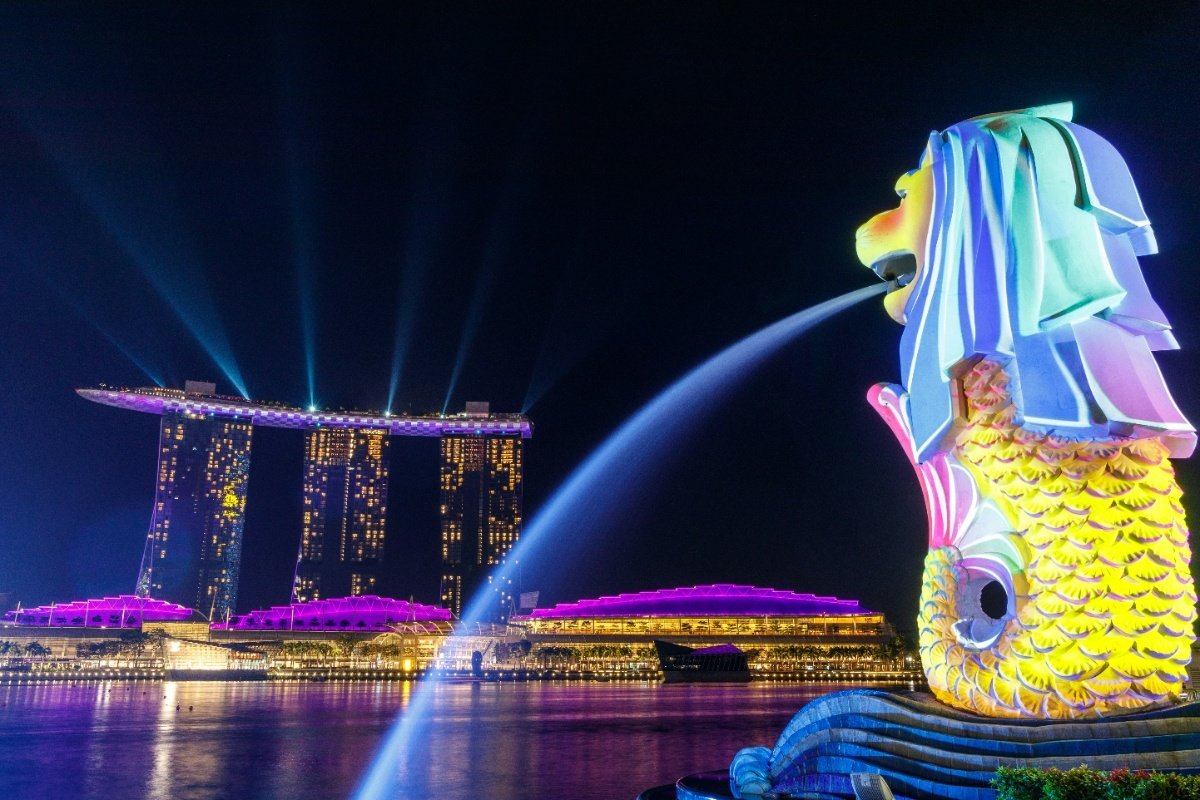
From $3 Michelin Stalls to $400 Tasting Menus: Navigating Singapore’s Food Spectrum
Sunset Weekly Disclosure: To help keep our guides free, this post contains affiliate links. If you click through and make a booking (such as hotels, flights, tours, or travel experiences), we may earn a commission at no extra cost to you. Sunset Weekly is an independent travel and lifestyle publication. While we may receive compensation from affiliate partners, this does not influence our editorial content, recommendations, or opinions. #ad
Quick Answer: Singapore operates simultaneously as one of Asia’s great hawker food destinations and one of its most developed fine dining cities. A Michelin-starred plate of chicken rice costs SGD 3 at a hawker stall. A three-Michelin-star tasting menu runs SGD 400+. Both experiences sit in the same city. Understanding where you are in this spectrum determines whether Singapore is one of Asia’s cheapest or most expensive food destinations.
Editorial note: This guide covers hawker culture, regional food enclaves, and dining across all price levels. Pricing reflects 2025–2026 conditions. No restaurants, tourism boards, or commercial operators have contributed to or influenced this content.
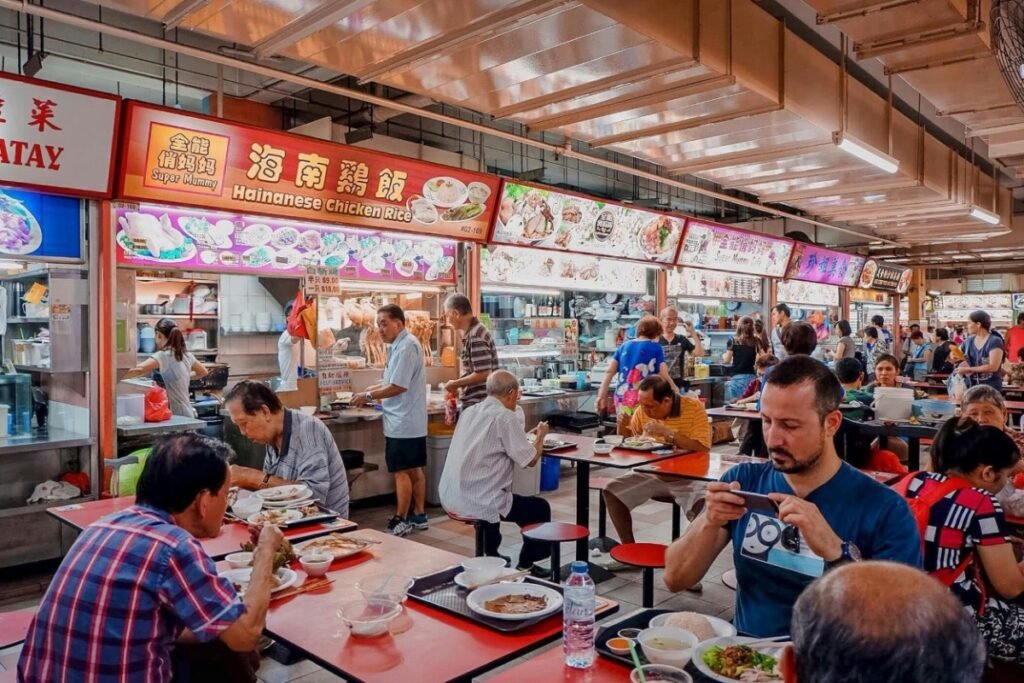
Singapore’s food identity is multi-ethnic and layered by design. Chinese, Malay, Indian, and Peranakan communities have cooked side by side for generations. Consequently, dishes that exist nowhere else — Hainanese chicken rice, Singapore-style laksa, chilli crab, kaya toast — emerged from this proximity. The hawker centre is the institution that made this accessible. It groups independent stalls under one roof, prices food at SGD 3–8 per plate, and draws residents from every income level. UNESCO recognised the hawker culture in 2020. Furthermore, the Michelin Guide also awards individual hawker stall operators — a combination that exists nowhere else on earth.
What Food Is Singapore Known For?
Answer: Singapore is known for Hainanese chicken rice (the national dish), chilli crab, laksa, kaya toast with soft-boiled eggs, char kway teow, bak kut teh, roti prata, and a hawker centre culture UNESCO has recognised as intangible cultural heritage. The city also holds more Michelin-starred restaurants than many European capitals, making it the most vertically integrated food destination in Southeast Asia.
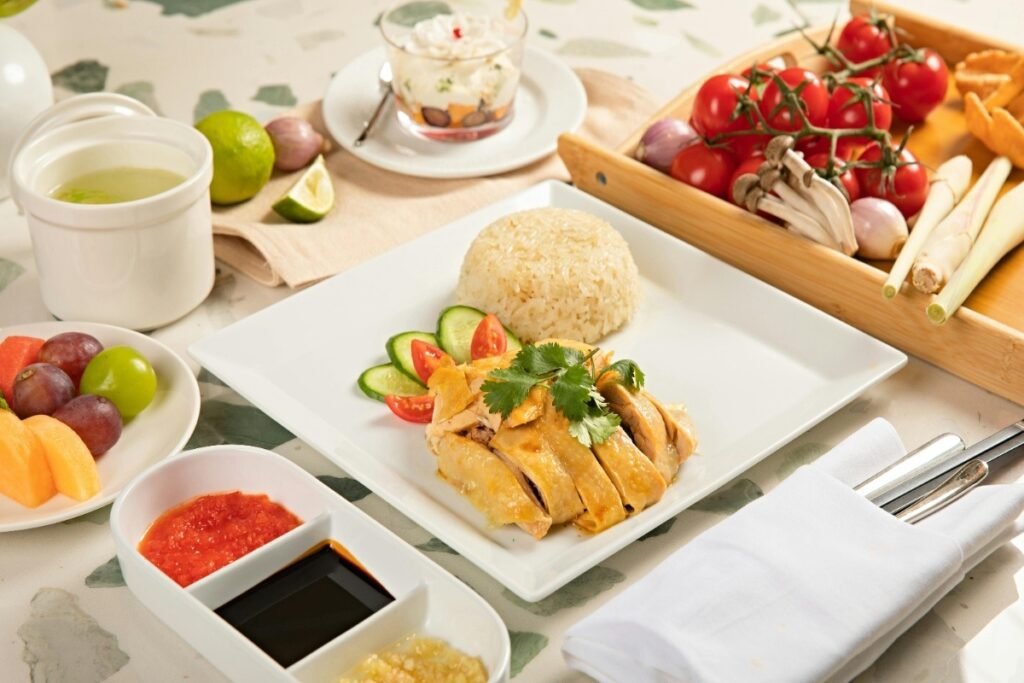
Singapore’s food reflects waves of immigration and the specific adaptations that emerged here. Hainanese immigrants who arrived as domestic cooks developed a poached chicken and rice dish using local techniques alongside traditional methods. Consequently, Hainanese chicken rice bears no resemblance to anything eaten in Hainan today. Similarly, Singapore laksa — rich coconut curry broth with noodles — differs from Penang’s sour asam laksa and KL’s curry laksa. Furthermore, even within Singapore, different stalls produce different versions of the same dish.
Peranakan (Nyonya) food represents the city’s most complex culinary tradition. It fuses Chinese cooking techniques with Malay spice pastes, producing dishes of unusual depth. Specifically, ayam buah keluak — chicken cooked with the nut of the keluak tree — requires days of preparation and carries a deep, earthy flavour unlike anything in either parent cuisine.
Essential Dishes: Rice, Noodles, and Seafood
| Dish | Community | What It Is | Best Context |
|---|---|---|---|
| Hainanese chicken rice | Chinese (Hainanese) | Poached chicken over fragrant rice; chilli sauce and ginger paste alongside | Hawker centres; Tian Tian at Maxwell is frequently cited |
| Chilli crab | Singaporean Chinese | Mud crab in a tomato-egg-chilli sauce; intensely messy, deeply flavoured | East Coast seafood restaurants; prices by weight |
| Black pepper crab | Singaporean Chinese | Whole crab in a dry, intensely spiced black pepper sauce | Same seafood restaurants as chilli crab; better for heat lovers |
| Laksa | Peranakan/Chinese | Coconut milk curry broth with thick noodles, prawns, and cockles | Hawker centres; 328 Katong Laksa is frequently cited |
| Char kway teow | Chinese (Hokkien) | Flat rice noodles stir-fried with cockles, egg, and beansprouts | Hawker centres; good versions use lard and wok hei |
| Bak kut teh | Chinese (Teochew) | Pork rib soup — peppery, clear Teochew version in Singapore | Specialist restaurants; distinct from the Malaysian version |
| Hokkien mee | Chinese (Hokkien) | Thick and thin noodles braised in prawn broth; finished with seafood | Hawker centres; Nam Sing at Old Airport Road frequently cited |
Essential Dishes: Snacks, Sweets, and Indian Classics
| Dish | Community | What It Is | Best Context |
|---|---|---|---|
| Kaya toast set | Singaporean Chinese | Toast with coconut-pandan jam and butter; served with soft-boiled eggs and kopi | Kopitiams; Ya Kun Kaya Toast has the widest network |
| Roti prata | Indian-Muslim | Flaky fried flatbread; plain, egg-filled, or with cheese; served with curry | 24-hour Indian mamak restaurants; widely available |
| Carrot cake (chai tow kway) | Chinese (Teochew) | No carrot; made from radish and rice flour cake, stir-fried black or white | Hawker centres; black version uses sweet soy sauce |
| Oyster omelette (orh luak) | Chinese (Hokkien) | Fresh oysters in a crispy-chewy starch omelette with sweet chilli sauce | Hawker centres; best versions have charred edges and plump oysters |
| Fish head curry | Indian (Tamil) | Whole fish head in a tamarind and coconut curry | Indian restaurants; a Singaporean-Indian invention |
| Satay | Malay/Singaporean | Grilled skewered meat with peanut sauce | Satay by the Bay; hawker centres |
| Ice kachang | Singaporean Chinese | Shaved ice with red beans, sweet corn, grass jelly, and coloured syrups | Hawker centres; a signature dessert on hot days |
Understanding Singapore’s Hawker Culture
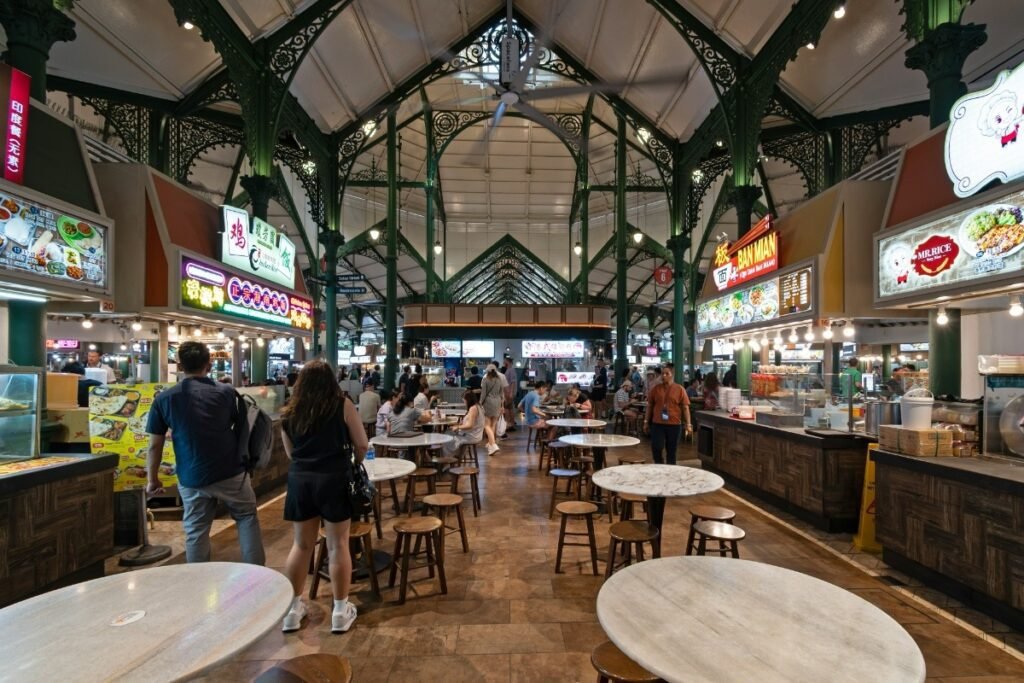
Answer: Singapore’s hawker centres are open-air food complexes grouping independent stalls under one roof. UNESCO recognised them in 2020. Most dishes cost SGD 3–8. Stall operators specialise narrowly in one or two dishes. The quality gap between a good hawker stall and a restaurant charging ten times the price is often negligible — and sometimes the hawker stall wins outright.
How Hawker Centres Work
Each hawker stall operates independently. Queue at the stall you want, order, pay, and return to a table. Drinks come from a separate vendor. Specifically, the most important first step is finding a seat before ordering — tables at busy centres fill quickly. Place a tissue packet or small personal item on a chair to “chope” (reserve) the seat. This system is universally understood and respected.
Stalls specialise narrowly. Consequently, a stall operator who has spent thirty years mastering a single dish typically outperforms a restaurant kitchen juggling fifty items. Furthermore, hawker stall queues carry real informational value. Singaporeans queue deliberately — they queue because the food justifies it. A twenty-minute queue at a hawker stall is a stronger quality signal than most restaurant reviews.
Which Hawker Centres to Prioritise
| Hawker Centre | Location | Character | Best For |
|---|---|---|---|
| Maxwell Food Centre | Chinatown, Central | Mid-sized, mix of tourist and local | Chicken rice; good overall quality |
| Old Airport Road Food Centre | Geylang, East | Large, primarily local | Hokkien mee, carrot cake; considered one of the best overall |
| Tekka Centre | Little India, Central | Primarily Indian; market below | Roti prata, fish head curry, Indian Muslim food |
| Lau Pa Sat | CBD, Central | Atmospheric; tourist-adjacent | Satay street in the evenings; good for first-timers |
| Newton Food Centre | Newton, Central | Tourist-facing; touts present | Worth visiting once; not for best value |
| Satay by the Bay | Marina Bay, Central | Outdoor; pleasant setting | Satay; good evening experience |
| Chomp Chomp Food Centre | Serangoon, North | Primarily local; evening hours | Char kway teow, satay; an authentic supper destination |
| Geylang Serai Market | Geylang, East | Malay-focused | Nasi lemak; festive during Ramadan |
Michelin Stars in the Hawker Context
Singapore maintains several hawker stall operators who have held Michelin recognition — Bib Gourmand and star level. Specifically, this represents a global anomaly. No other country assigns Michelin recognition to street food stalls in hawker centres. The starred stalls attract long queues. Additionally, the recognition has driven prices at some stalls marginally above hawker norms while remaining well below restaurant prices.
Singapore’s Food Enclaves
Answer: Singapore’s multi-ethnic communities maintain distinct food geographies. Chinatown concentrates Chinese hawker food in the central area. Little India brings Tamil and North Indian cooking to Serangoon Road and Tekka Market. Kampong Glam delivers Malay and Arab food along Arab Street. Katong and the East Coast hold the most celebrated Peranakan restaurants and Singapore’s seafood strip.
Chinatown and the Central Area
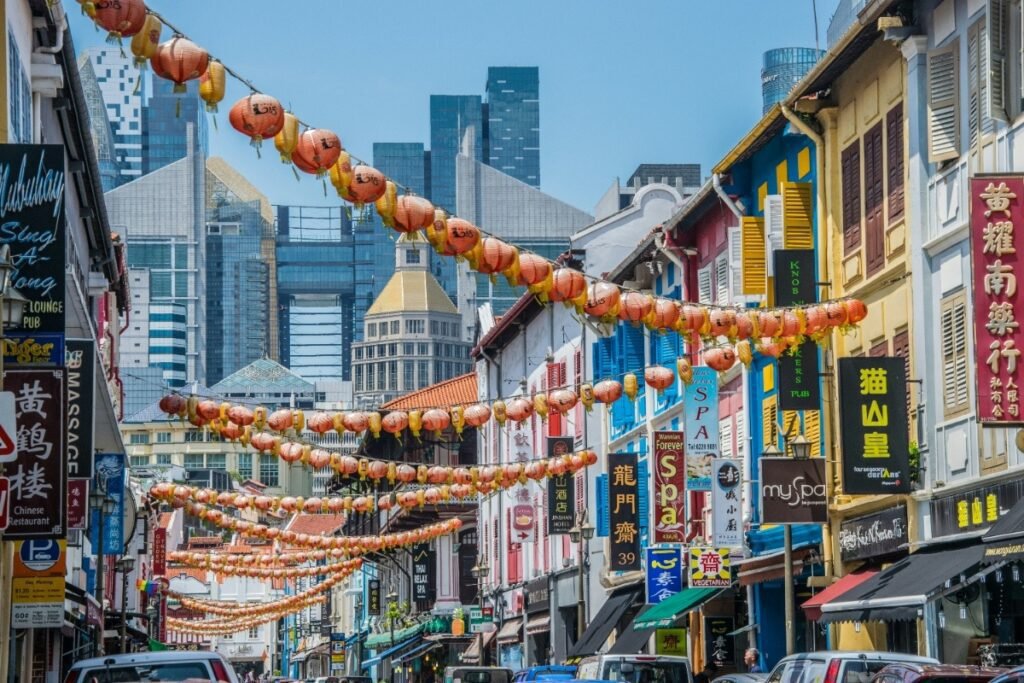
Chinatown delivers the highest density of Chinese hawker food in central Singapore. Maxwell Food Centre and the Chinatown Complex Food Centre on Smith Street anchor the area. Additionally, the streets around Keong Saik Road have developed into one of Singapore’s most interesting restaurant corridors — modern Singaporean cooking, wine bars, and international restaurants in heritage shophouses.
Little India and Tekka Market
Tekka Market on Serangoon Road anchors Little India’s food scene. The upper floor holds hawker stalls with the best roti prata, fish head curry, and South Indian rice and curry in Singapore. Furthermore, the streets surrounding Tekka — Dunlop Street and Buffalo Road — hold Indian Muslim restaurants serving biryani, murtabak (stuffed flatbread), and teh tarik.
Banana leaf rice lunches appear at several restaurants around the Serangoon Road corridor. Consequently, this area provides the most reliable, affordable vegetarian eating in the city.
Kampong Glam and Katong
Kampong Glam represents Singapore’s Malay cultural heartland. The food here centres on nasi padang (Malay rice with multiple side dishes) and various Malay rice and noodle dishes. Hajjah Maimunah has maintained a strong local reputation for decades. Specifically, arriving before noon produces a full selection — dishes sell out by early afternoon.
Katong is Singapore’s most celebrated Peranakan neighbourhood. The stretch of East Coast Road concentrates laksa, Peranakan restaurants, and Nyonya kueh shops. Specifically, Katong laksa — a thick coconut curry laksa with cut noodles eaten entirely with a spoon — represents the most distinctively Singaporean version of the dish.
How Expensive Is Food in Singapore?
Answer: Singapore operates across an extraordinary price range. Hawker centre meals cost SGD 3–8. Fine dining tasting menus run SGD 200–400+. Mid-range restaurants sit at SGD 30–80 per person. Additionally, sit-down restaurants add 9% GST and typically a 10% service charge — bringing the effective premium over menu prices to approximately 19%. Budget for this before ordering.
Pricing by Context
| Meal Type | SGD | Approx. GBP | Notes |
|---|---|---|---|
| Hawker stall single dish | 3–8 | £1.75–£4.65 | The baseline for Singapore eating |
| Kaya toast set (toast, eggs, kopi) | 5–9 | £2.90–£5.25 | The definitive Singapore breakfast |
| Hawker centre full meal (2 dishes + drink) | 8–18 | £4.65–£10.50 | Realistic total for a filling hawker meal |
| Casual restaurant lunch | 20–45 | £11.65–£26.20 | Before 9% GST and 10% service charge |
| Mid-range dinner (per person) | 50–100 | £29–£58 | Before the 19% service and tax add-on |
| Chilli crab (per crab, market price) | 80–160+ | £46.50–£93+ | Price varies by crab size and restaurant |
| Fine dining tasting menu | 200–450 | £116–£261 | Before wine pairing |
| Tiger Beer (hawker centre) | 8–12 | £4.65–£6.98 | Alcohol pricing reflects sin taxes |
| Singapore Sling (Raffles Long Bar) | 37+ | £21.50+ | Tourist experience; the price is the point |
| Kopi-o (hawker centre) | 1.20–2.50 | £0.70–£1.45 | One of Asia’s great coffee values |
The GST and Service Charge Reality
Singapore restaurants add GST (9%) and a service charge (typically 10%) on top of menu prices. Together these add approximately 19% to every bill. Specifically, a dinner priced at SGD 100 on the menu costs SGD 119 when settled. Hawker centres and most kopitiams do not add these charges. Consequently, the hawker centre price is the actual price paid — the restaurant price requires mental adjustment before ordering.
Singapore’s Kopi Culture and Breakfast Traditions
Answer: The Singapore kopitiam breakfast — kaya toast, soft-boiled eggs, and kopi — is one of the most satisfying cheap meals in Asia. Kopi differs entirely from espresso coffee. The ordering system uses specific codes: kopi-o (black with sugar), kopi-c (with evaporated milk), kopi-o kosong (black without sugar). Mastering this system opens access to a genuinely local daily ritual that costs under SGD 5.
The Kaya Toast Ritual
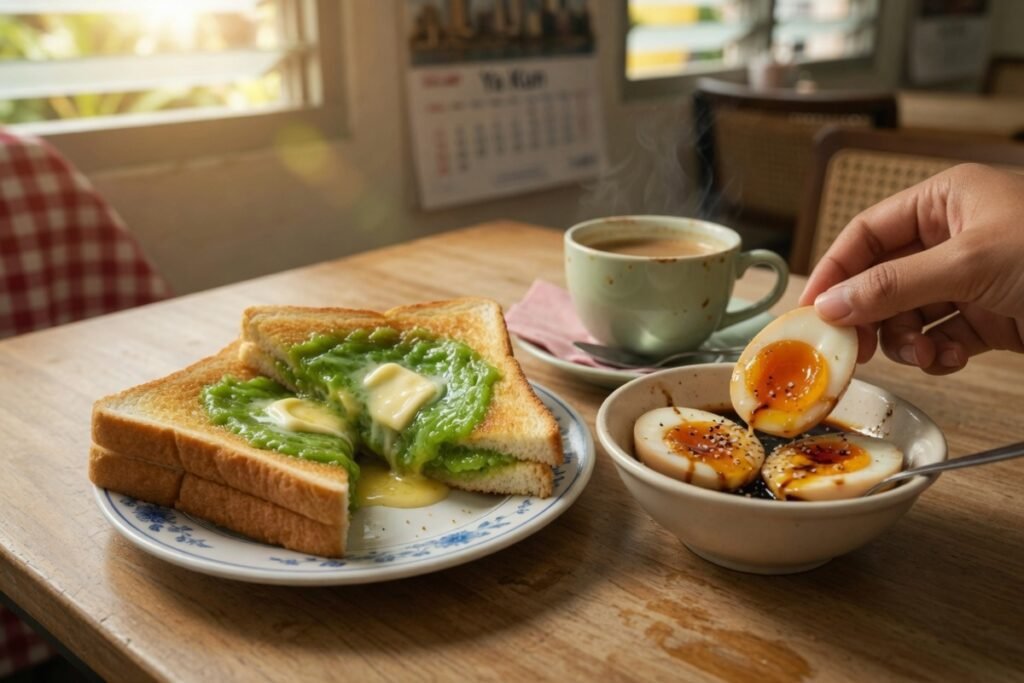
Kaya toast involves toasting thick white bread, spreading it with kaya (a coconut-pandan jam made with eggs) and cold butter. The toast arrives alongside two half-boiled eggs in a small bowl. Dark soy sauce and white pepper go over the eggs. Diners dip the toast into the egg mixture.
This breakfast costs SGD 5–9 at a kopitiam or dedicated chain. However, an old-school kopitiam — wooden furniture, ceiling fans, a kopi uncle brewing through a muslin sock — produces a context that chains replicate in format but not in atmosphere. Consequently, seeking an independent kopitiam in an HDB estate or on a side street in Chinatown produces a better breakfast than any airport or mall version.
The Kopi Ordering System
| Order | What It Means |
|---|---|
| Kopi | Coffee with condensed milk (hot) |
| Kopi-o | Black coffee with sugar (hot) |
| Kopi-c | Coffee with evaporated milk and sugar (hot) |
| Kopi-o kosong | Black coffee, no sugar (hot) |
| Kopi-peng | Coffee with condensed milk over ice |
| Teh | Tea with condensed milk (hot) |
| Teh tarik | Pulled tea with condensed milk; frothy |
| Teh-o | Black tea with sugar (hot) |
| Milo dinosaur | Cold Milo with extra Milo powder on top |
Singapore’s Drinking Culture
Answer: Singapore operates a serious cocktail bar culture, a developing craft beer scene, and a deep-rooted kopi and teh tradition. Alcohol is expensive due to sin taxes. Tiger Beer is the local lager. The Singapore Sling at Raffles Long Bar costs SGD 37+ and represents a tourist experience rather than a bar culture one. However, the independent bar scene in Keong Saik Road and Ann Siang Hill offers genuinely good cocktails at prices that reflect craft rather than heritage marketing.
Tiger Beer and the Singapore Sling Question
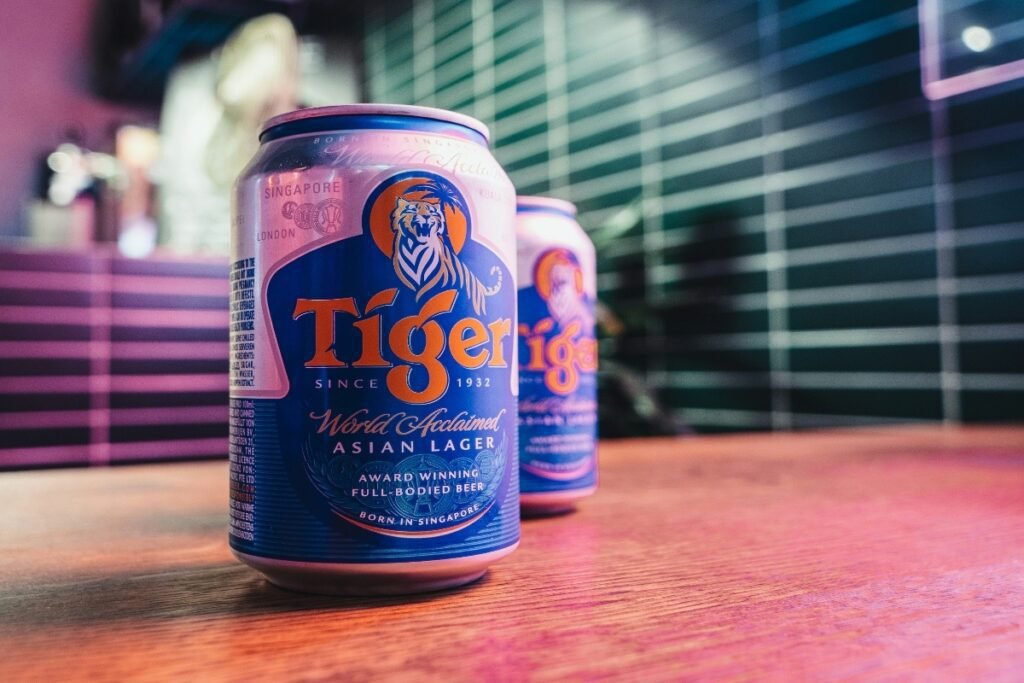
Tiger Beer — brewed in Singapore since 1932 — is the dominant local lager. A Tiger at a hawker centre costs SGD 8–12. At a rooftop bar or hotel, the same beer costs SGD 18–28.
Raffles Hotel Long Bar reportedly created the Singapore Sling in the early 1900s. Current pricing runs SGD 37+. Valid as a one-off historical experience — however, returning for a second is difficult to justify on quality grounds alone. Specifically, Singapore’s independent cocktail bar culture in Keong Saik Road, Ann Siang Hill, and Tanjong Pagar produces genuinely award-recognised drinks at SGD 22–32.
Non-Alcoholic Drinks
Fresh sugar cane juice from hawker stalls costs SGD 1.50–3. Barley water — a sweet, slightly mineral cold drink — appears at most hawker centres for SGD 1–2. Additionally, fresh lime juice with soda (limau ice) provides the most refreshing non-alcoholic option in Singapore’s heat. Specifically, these drinks cost a fraction of equivalent beverages at cafés and restaurants.
What Should Tourists Avoid?
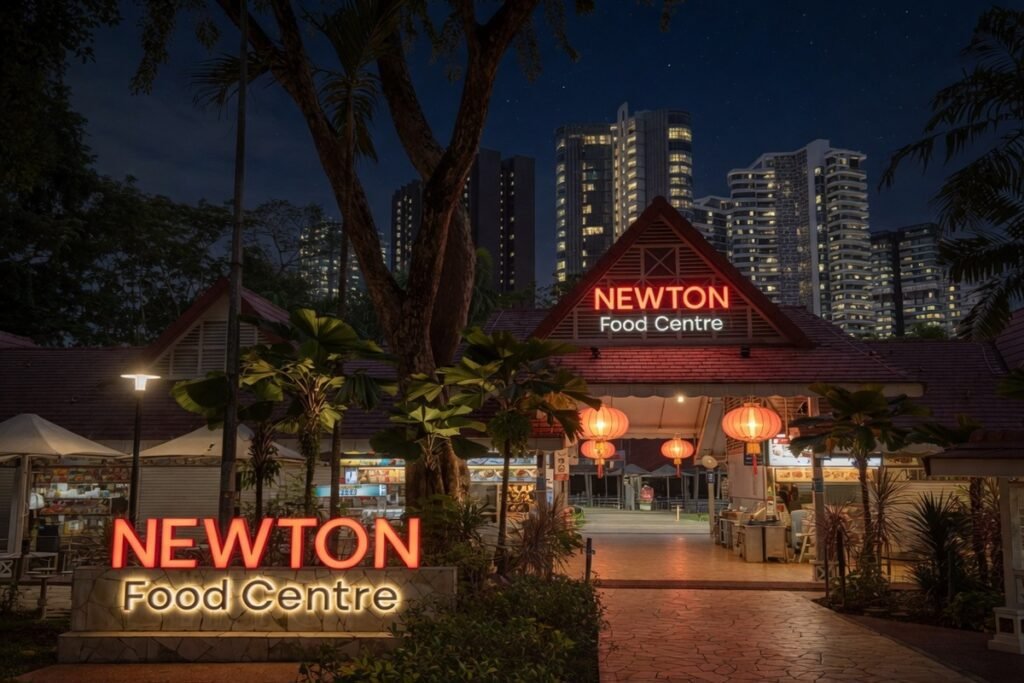
Answer: Newton Food Centre is Singapore’s most consistently criticised tourist-facing hawker centre. Touts actively recruit diners and prices exceed comparable stalls at genuinely local centres by 30–50%. Similarly, food courts inside Orchard Road malls charge elevated prices for standard quality. Additionally, seafood restaurants require weight confirmation before cooking — not doing this produces surprise bills.
Specific Traps
Newton Food Centre touts: The centre retains some good stalls. However, staff physically intercept tourists and steer them toward specific stalls. Prices at tout-facing stalls run 30–50% above comparable food at Old Airport Road or Maxwell. Specifically, the satay and seafood stalls nearest the entrance operate most aggressively and represent the least accurate picture of Singapore hawker pricing.
Orchard Road mall food courts: The food courts inside ION, 313@Somerset, and Ngee Ann City charge SGD 12–25 for dishes costing SGD 5–8 at a genuine hawker centre. The quality rarely justifies the premium. Specifically, air conditioning is the primary differentiator — and Singapore’s genuine hawker centres increasingly have fans and shading that make outdoor eating comfortable.
Seafood restaurant weight ambiguity: Chilli crab and black pepper crab price by weight. The crab arrives pre-cooked from the kitchen. Consequently, always ask the server to confirm the weight and estimated total before cooking begins. This is standard practice and not considered rude.
Traveller Practicality: Vegetarians, Families, Dietary Needs
Answer: Vegetarians eat well in Singapore through Indian vegetarian restaurants, dedicated Chinese vegetarian establishments marked with the yellow 素 sign, and many naturally meat-free hawker dishes. Families eat at hawker centres without any awkwardness. Halal food concentrates in Kampong Glam and Tekka Market. However, pork appears widely in Chinese hawker food — often invisibly in seasoning and cooking fat.
Vegetarian and Halal Navigation
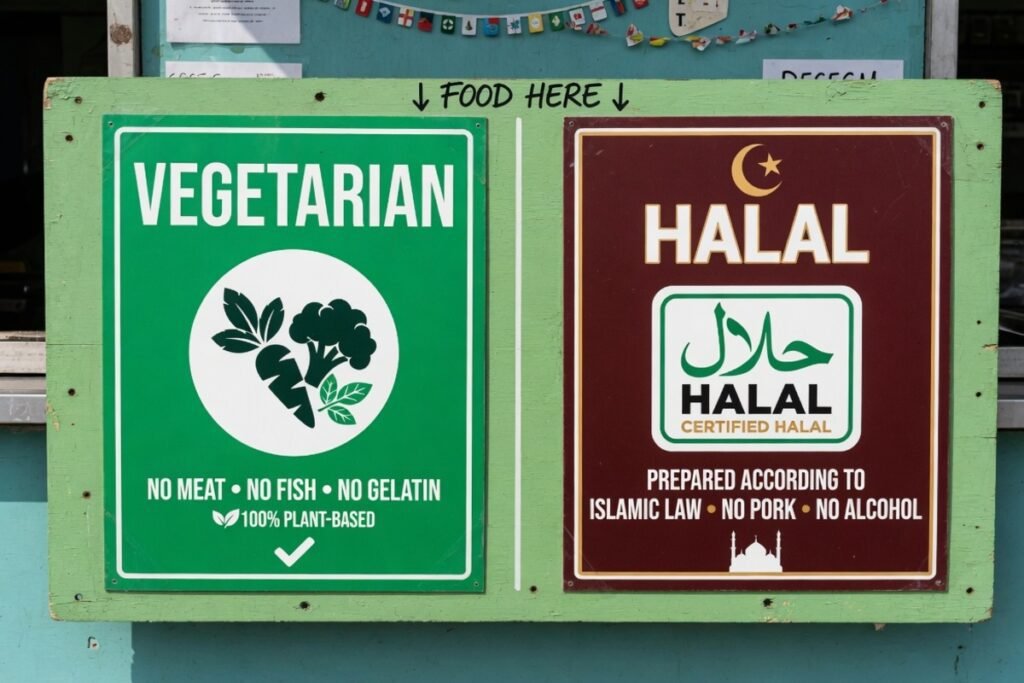
Indian vegetarian restaurants in Little India produce excellent banana leaf rice lunches and South Indian snacks. Additionally, Buddhist Chinese vegetarian restaurants (marked with the yellow 素 sign) serve meat-free Chinese dishes at hawker-comparable prices. Furthermore, several hawker stalls explicitly mark their offerings as vegetarian.
Halal certification applies to all Malay and Indian Muslim stalls. Specifically, stalls at Tekka Market and Geylang Serai Market are entirely halal. However, Chinese hawker stalls at mixed centres frequently use lard — pork products appear in cooking even when not listed as a primary ingredient.
Allergy Notes
Peanuts appear in satay sauces, rojak dressing, and various Malay and Peranakan dishes. Shellfish appears in laksa broth, char kway teow, and many other dishes even when not the primary ingredient. Specifically, the small size of hawker stalls means cross-contamination between different proteins is essentially inevitable. Travellers with serious allergies should communicate these clearly at every interaction and consider dedicated vegetarian or allergen-aware establishments.
Local Dining Etiquette in Singapore
Answer: Singapore’s hawker etiquette is simple and consistent. Chope (reserve) a seat with a tissue packet before ordering. Queue at each stall individually. Pay per stall, not collectively. Nobody expects a tip at hawker centres or casual restaurants. However, the 10% service charge at restaurants functions as a mandatory gratuity — staff expect no further gratuity beyond it.
The Chope System and Hawker Basics
Placing a tissue packet, a key, or a small personal item on a hawker centre chair reserves that seat while you order. This is the chope system — universally observed in Singapore. Removing someone else’s choped item and sitting down produces immediate friction. Consequently, a tissue packet holds a seat even when the chair looks vacant.
Bills at hawker centres arrive per stall. Specifically, pay each stall when collecting food or when the vendor brings it. Card payments are increasingly available through mobile payment systems. However, carrying SGD 5, 10, and 20 notes facilitates smoother transactions at older stalls.
Tipping and Service Charges
At sit-down restaurants, staff expect no tip beyond the mandatory 10% service charge. This charge funds wages and appears as a line item rather than an optional gesture. Consequently, leaving additional money after paying a bill already carrying the service charge is unnecessary. At hawker centres, kopitiams, and casual cafés, nobody expects any tip.
Best Areas for Food by Budget and Traveller Type
| Traveller Type | Best Area | Why |
|---|---|---|
| Hawker culture immersion | Old Airport Road Food Centre | Primarily local; consistently rated among the best centres overall |
| Budget eating | Any HDB estate hawker centre | Lowest prices; most local atmosphere; no tourist surcharge |
| Peranakan cuisine | Katong / East Coast Road | Most concentrated Peranakan restaurant and laksa scene |
| Indian food | Little India (Tekka Market) | Best roti prata, fish head curry, and banana leaf rice in the city |
| Malay and halal | Kampong Glam / Geylang Serai | Nasi padang, murtabak, and Malay sweets at their most authentic |
| Seafood | East Coast seafood strip | Chilli crab and black pepper crab at reputable restaurants |
| Fine dining and cocktails | Keong Saik Road / Tanjong Pagar | Modern Singaporean cuisine; award-recognised cocktail bars nearby |
| Short stay (1–2 days) | Maxwell + Chinatown + Little India walk | Covers three main food traditions in a single afternoon |
| Supper culture | Chomp Chomp or Geylang | Late-night eating; durian from street vendors during season |
Where To Stay in Singapore?
IHG operates one of the broadest hotel portfolios in Singapore, spanning luxury (InterContinental, Regent), upscale (Crowne Plaza, voco, Hotel Indigo), midscale (Holiday Inn), and value (Holiday Inn Express) under seven brands. The practical decision is rarely “which is best overall” but “which neighbourhood and brand matches the trip purpose”. On-the-ground patterns show: Orchard Road for direct shopping and central MRT access; Clarke Quay for riverfront nightlife with Fort Canning MRT convenience; Katong for a slower-paced east-coast local vibe; and Little India or Novena for stronger value, multiple MRT lines, and easier access to medical hubs or cultural streets.
IHG deliberately avoids presenting Singapore as a single uniform product. Instead, the same loyalty programme delivers markedly different operational realities: Holiday Inn Express properties prioritise included breakfast, compact rooms, and limited service for shorter stays, while voco, Hotel Indigo, and full-service Holiday Inn hotels invest more heavily in design, on-site dining, and facilities. With exactly 15 hotels listed on IHG’s Singapore page across seven brands, the group provides strong consistency on booking, points earning/redemption, and flexible cancellation terms, particularly valuable for repeat visitors who value programme predictability over chasing independent properties.
| Hotel & Location | Best For | Unique Feature | Verified Rating | Action |
|---|---|---|---|---|
|
Holiday Inn Express Singapore Clarke Quay 2 Magazine Road, Singapore 059573 |
Value City Breaks | 40-metre rooftop swimming pool with whirlpools; free Express Start Breakfast or Grab & Go. | 4.46/5 | BOOK NOW |
|
Hotel Indigo Singapore Katong 86 East Coast Road, Singapore 428788 |
Boutique Character | Built on the historic grounds of the former Joo Chiat Police Station; rooftop infinity pool. | 4.70/5 | BOOK NOW |
|
voco Orchard Singapore 581 Orchard Road, Singapore 238883 |
Orchard Shopping | Prime Orchard Road address with dining, shopping, and entertainment at the doorstep. | 4.39/5 | BOOK NOW |
|
Holiday Inn Singapore Orchard City Centre 11 Cavenagh Road, Singapore 229616 |
Family & Leisure | Kids eat free, three on-site restaurants, pool, fitness centre, and parking. | 4.42/5 | BOOK NOW |
|
Holiday Inn Singapore Little India 10 Farrer Park Station Road, Singapore 217564 |
Heritage & Transit | Sits atop Farrer Park MRT station with panoramic district views and an outdoor pool. | 4.40/5 | BOOK NOW |
Important Things Travellers Should Know Before Eating in Singapore
Costs, Timing, and Ordering
- Add 19% to all restaurant menu prices. GST (9%) and service charge (10%) appear on every sit-down restaurant bill. The price on the menu is never the final price paid. Hawker centres and most kopitiams do not add these charges. Specifically, budgeting for this difference prevents surprise at settling time.
- Hawker stalls have variable operating hours. Not all stalls open every day. Some close in the early afternoon. Specifically, calling ahead or checking social media before making a dedicated trip is advisable for the most celebrated vendors.
- Supper culture runs very late. Many hawker centres operate until midnight or beyond. Specifically, Geylang operates food stalls and durian vendors until 02:00–03:00 on weekends. Furthermore, 24-hour roti prata restaurants across the city serve the supper-to-dawn crowd reliably.
- Durian season peaks June to August. Mao Shan Wang, D24, and Black Thorn varieties reach Singapore’s street vendors during this window. Specifically, Geylang concentrates the most active durian vendor culture. Additionally, durian bans apply on most public transport and in most hotels — the smell carries logistical consequences that require planning.
Chicken Rice, Long Queues, and Practical Notes
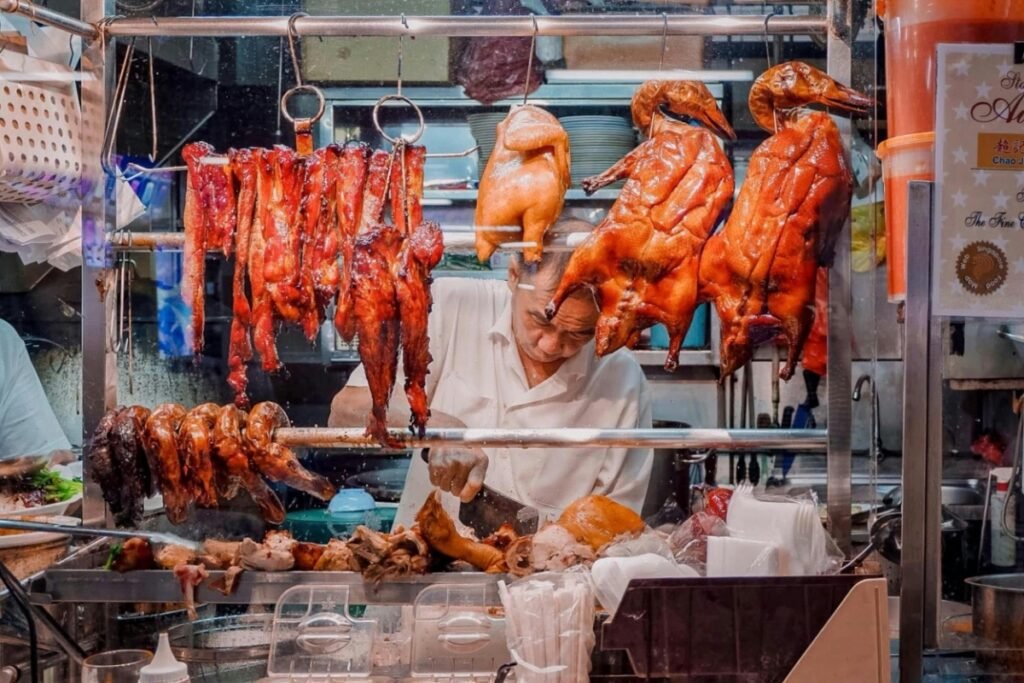
- Chicken rice requires specifying roasted or poached. Roasted chicken has crispier skin; poached chicken is more tender and traditional. The rice — cooked in chicken stock with ginger — matters as much as the chicken. A stall producing poor rice despite excellent chicken misses the point of the dish.
- The long queue means something. Singaporeans queue with intent. A 30-minute wait at a hawker stall reflects genuine quality assessment by people who eat there weekly. However, tourist-adjacent stalls have queues that partially reflect social media visibility rather than pure quality. Applying judgment between the two improves the outcome.
- Cash remains relevant at hawker centres. PayNow and Singapore’s PayLah app work at many stalls. However, older hawker operators may still prefer cash. Carrying SGD 40–60 in small notes ensures access to every stall.
Frequently Asked Questions About Food in Singapore
Hawker Centres, Dishes, and Classics
What is the national dish of Singapore? Hainanese chicken rice holds that status in practice, though no official designation exists. Specifically, the dish involves poaching a whole chicken in a seasoned broth, then using that broth to cook jasmine rice with ginger and garlic. The quality of Singapore chicken rice lives in the rice as much as the chicken. A stall producing fragrant, lightly oily rice from a quality broth represents the dish at its best. Furthermore, the chilli sauce and ginger paste served alongside are integral to the experience — the chicken eaten alone misses the point.
What is the difference between Singapore laksa and Penang laksa? These dishes share a name but differ fundamentally. Singapore laksa uses a rich coconut milk curry broth with prawns, cockles, tofu puffs, and thick rice noodles. Penang asam laksa uses a sour tamarind fish broth with mackerel and a shrimp paste garnish — entirely different in flavour, spicing, and texture. Consequently, ordering laksa in Singapore expecting the Penang version produces surprise. Both are excellent; however, they are simply not the same dish.
Is chilli crab actually spicy? The heat level in chilli crab sauce is moderate rather than aggressive. The sauce — a mixture of tomato paste, eggs, chilli, and garlic — produces a rich, slightly sweet result with mild background heat. Specifically, it is considerably less spicy than the name suggests. Black pepper crab, by contrast, delivers a dry, assertive spice hit from the coarsely ground pepper coating. Both dishes arrive whole and require physical effort — the messiness is part of the experience and should not deter anyone.
Practical Dining Questions
How do I order at a Singapore hawker centre? Find a seat first and place a tissue packet on it to reserve. Then walk to whichever stalls appeal. Read the menu boards, order at the counter, and pay at each stall separately. Drinks come from a dedicated drinks stall. Specifically, asking “what’s good today?” at smaller stalls occasionally produces useful advice from vendors who know their strongest dish that session. Furthermore, ordering multiple dishes to share across a group — rather than one dish per person — reflects the natural eating rhythm of a hawker centre.
What is the best hawker centre for first-time visitors? Maxwell Food Centre in Chinatown provides the best combination of accessibility and genuine quality for first-time visitors. It is centrally located, well-maintained, and air-conditioned in sections. Additionally, the range of dishes covers most of Singapore’s hawker staples. However, Old Airport Road Food Centre in the east produces more consistently local eating at slightly lower prices. The trade-off is a less central location requiring a short taxi or MRT journey.
© 2026 — Editorial travel content. Not affiliated with the Singapore Tourism Board, the Singapore Food Agency, any hawker stall operator, or any commercial food or hospitality operator. Pricing reflects 2025–2026 conditions and is subject to change.
Editorial & Accuracy Standards
- Expert Review:
Ammara Azmat,
Senior Travel Mobility Analyst (12+ years experience) - Status: Verified for accuracy against official 2026 service data and real-time traveller reports.
- Our Process: This content follows our Fact-Checking Policy.